
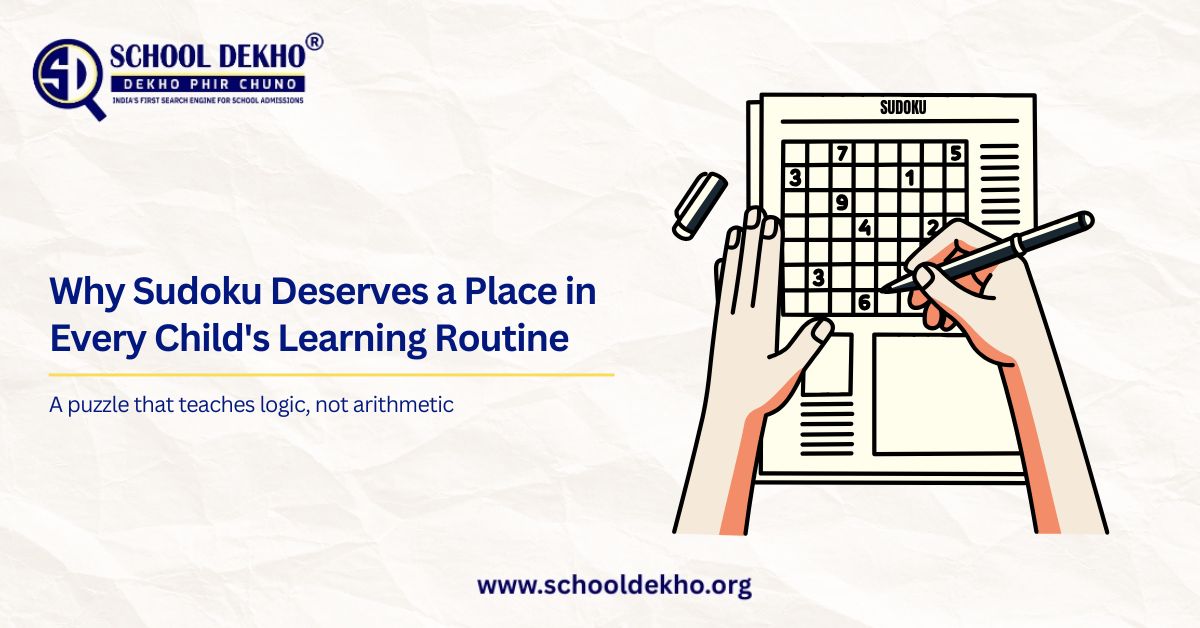
Ask most parents what they want for their child's education and the answer rarely stops at good marks. They want a child who can think clearly, stay patient with a difficult problem, and feel confident rather than anxious when numbers appear on the page. Those qualities are harder to teach than facts, and they don't come from a textbook alone. Sometimes the most effective learning tools are the ones that don't look like schoolwork at all. Sudoku is a perfect example.
At first glance it's just a grid of numbers, the sort of thing you might find in a newspaper. But spend a little time watching a child work through one and you'll see something valuable happening. They're reasoning, testing ideas, correcting mistakes, and slowly building the kind of thinking habits that support every subject they'll ever study. Best of all, they're usually enjoying it, which is the quiet secret behind all good learning.
A puzzle that teaches logic, not arithmetic
One of the most common misconceptions about Sudoku is that it's a maths puzzle. It isn't, and that's an important point for parents whose children feel nervous about numbers. You never add, subtract, or multiply anything. The digits one to nine are simply nine different symbols, and the entire challenge is about placing each of them correctly so that no row, column, or box repeats.
What that means in practice is that Sudoku teaches pure logical reasoning. A child learns to look at the evidence in front of them, rule out what can't be true, and deduce what must be. That "if this, then that" thinking is the foundation of mathematics, science, and clear writing alike. And because there are no sums involved, even a child who dreads maths can succeed at it, which often does wonders for their confidence with numbers more generally.
Building focus in an age of distraction
Every teacher and parent today shares the same worry: attention spans are shrinking. Children are growing up surrounded by screens designed to interrupt them every few seconds, and sitting quietly with a single task has become genuinely difficult for many young learners.
A Sudoku grid gently rebuilds that muscle. To solve one, a child has to hold several pieces of information in mind at once and concentrate long enough to follow a chain of reasoning to its end. There are no flashing rewards or notifications, just the calm, absorbing pull of a problem that wants solving. Ten quiet minutes with a puzzle is a small but real act of focus training, and unlike a lecture about paying attention, children actually want to do it.
The confidence that comes from getting it right
There's a particular kind of pride on a child's face when they complete a Sudoku grid entirely on their own. Nobody handed them the answer. They worked it out, step by careful step, and the finished grid is proof. That feeling matters enormously.
Confidence in learning is built from lots of small wins, and Sudoku is a machine for producing them. Start a child on easy grids with plenty of clues and they'll succeed quickly, which makes them eager to try again. As they improve, the puzzles can grow harder at exactly the pace that suits them. This gentle, self-directed progression teaches a lesson that goes far beyond the grid: that a hard problem is not something to fear but something you can break down and beat with patience.
How parents and teachers can use it at home and in class
The beauty of Sudoku as an educational tool is how little it demands. There's no app to buy, no equipment beyond a pencil, and no special training needed to guide a child through it. A batch of printed grids and ten spare minutes is genuinely all it takes.
For younger children, start small. Four-by-four and six-by-six grids use fewer numbers and are far less intimidating than the full nine-by-nine, yet they teach exactly the same logic. As a child's skill grows, move up in size and difficulty. Keeping a small supply of printed puzzles on hand makes this effortless, and a convenient way to prepare them is a free generator such as Sudoku Printable. You choose the grid size, difficulty, and paper format, then print a clean sheet in seconds, with the answer key included so you or the child can check the work afterwards.
In the classroom, printed puzzles work beautifully as settling activities at the start of a lesson, quiet-time tasks, or rewards for finishing other work. Because you can print a whole set at once, differentiating for a mixed-ability group is easy: hand the confident children a harder grid and the ones still finding their feet an easier one, and everybody is engaged with the same kind of thinking at their own level.
A few gentle tips for getting the most out of it
The goal is enjoyment first, because a child who associates puzzles with pressure will quietly stop wanting to do them. Let them work at their own pace and resist the urge to jump in with the answer the moment they pause. Being stuck, and then working their own way out of it, is where the real learning happens.
Encourage them to use a pencil so mistakes feel low-stakes and easy to fix. Teach them the simple habit of pencilling in the possible numbers for a tricky square, which shows them that good thinking is often about narrowing options rather than guessing. And celebrate a completed grid, however easy it was, because that small sense of achievement is exactly what keeps them coming back.
More than just a puzzle
It's worth remembering that the skills Sudoku builds, patience, logical reasoning, focus, and the confidence to tackle a hard problem, are precisely the skills that help a child thrive across every subject at school and long after they leave it. Few activities deliver so much genuine educational value while feeling so little like work.
You don't need a special programme or an expensive resource to give your child these advantages. A pencil, ten quiet minutes, and a freshly printed grid are enough to start. Whether you're a parent looking for a screen-free activity that actually does some good or a teacher searching for something that engages a whole class at once, the humble Sudoku grid is a small tool that punches far above its weight. Print a few, hand them over, and watch how quickly a child leans in to work out what goes where.


.webp)
.webp)