
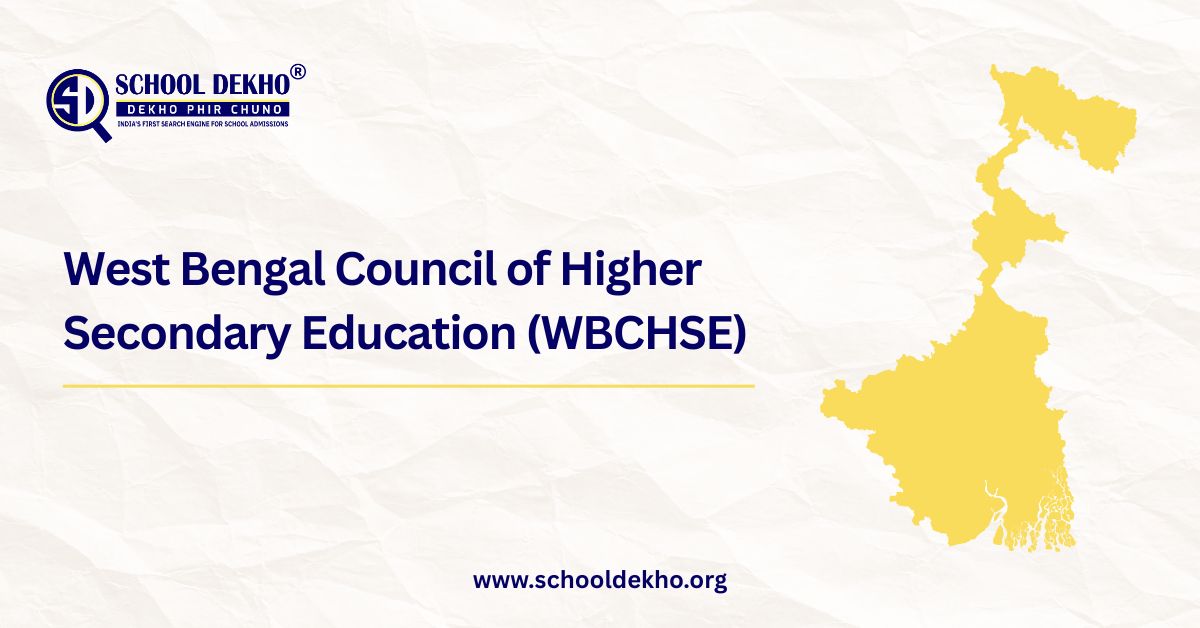
The West Bengal Council of Higher Secondary Education (WBCHSE) is the statutory examining authority responsible for conducting the Higher Secondary (Class 12) examinations in the state of West Bengal, India. Commonly known as the WBCHSE or the council for Uccha Madhyamik Pariksha, it regulates and oversees higher secondary education (Classes XI and XII) for both government and private schools affiliated with it. Established under the West Bengal Council of Higher Secondary Education Act, 1975, the WBCHSE operates as an autonomous body under the Department of School Education, Government of West Bengal. Its primary mandate includes curriculum development, syllabus prescription, affiliation of institutions, conduct of examinations, and award of certificates that qualify students for higher education and employment.
The WBCHSE plays a pivotal role in shaping the educational landscape of West Bengal, serving over 18 lakh students enrolled in Classes XI and XII across nearly 6,900 affiliated institutions. It ensures standardization of higher secondary education while adapting to national policies and state-specific needs, including the introduction of a pioneering semester system.
Quick Facts Table
| Attribute | Details |
|---|---|
| Founded | April 3, 1975 |
| Headquarters | Vidyasagar Bhavan, 9/2, Block-DJ, Sector-II, Salt Lake, Kolkata-700091 |
| Jurisdiction | West Bengal, India (government and private higher secondary schools) |
| Type | Government School Education Board |
| Official Website | wbchse.wb.gov.in |
| Parent Organization | Department of School Education, Government of West Bengal |
| Current President | Prof. (Dr.) Partha Karmakar |
| Key Examination | Higher Secondary (HS) Examination (Uccha Madhyamik Pariksha) |
| Students Appearing Annually | Over 8 lakh |
| Affiliated Institutions | Approximately 6,900 |
History and Establishment
The origin of the West Bengal Council of Higher Secondary Education (WBCHSE) traces back to the need for a dedicated regulatory body for post-secondary school education in the state. Prior to 1975, higher secondary education (then known as the Intermediate course) was managed by the University of Calcutta. The separation of secondary and higher secondary levels became necessary to streamline administration and focus on Class XI-XII education.
The Government of West Bengal enacted the West Bengal Council of Higher Secondary Education Act, 1975, leading to the formal establishment of the WBCHSE on April 3, 1975. It became a body corporate with perpetual succession and a common seal, empowered to acquire property, enter contracts, and perform all acts necessary for higher secondary education.
Key timeline of developments:
- 1975: Establishment under the WBCHSE Act.
- 1978: First Higher Secondary Examination conducted by the Council (replacing Calcutta University’s Intermediate examination).
- 2005 and 2013: Major syllabus revisions and curriculum updates.
- 2007: Shift from combined Class XI-XII evaluation to separate annual examinations for each class; introduction of mandatory school-level Test Examinations.
- 2024-25: Introduction of the semester system for Class XI (Semesters I and II); full implementation for Class XII (Semesters III and IV) from 2025-26 — the first such system at the higher secondary level in India.
- 2025: Celebration of 50 glorious years (1975-2025).
The Council’s headquarters is at Vidyasagar Bhavan in Salt Lake, Kolkata, with four regional offices supporting decentralized operations. Over the decades, the WBCHSE has expanded its reach, incorporating vocational subjects and aligning with evolving national education policies.
Objectives and Functions
The WBCHSE’s core objectives, as outlined in the 1975 Act, are to promote, develop, and regulate higher secondary education in West Bengal. Its primary functions include:
- Advising the State Government on all matters relating to higher secondary education.
- Laying down policies for the development of higher secondary education and periodic assessment of educational needs.
- Prescribing curricula, syllabi, courses of study, and textbooks.
- Granting recognition/renewal to higher secondary institutions and permitting new subjects or co-education.
- Conducting public examinations at the end of Class XII (and now semester-wise assessments).
- Publishing results, issuing certificates, and awarding scholarships.
- Upgrading institutions to the +2 level and supervising affiliated schools.
The Council also prepares and sells textbooks, maintains standards through teacher training and orientation programs, and ensures equitable access to quality education across urban and rural areas.
Organizational Structure
The WBCHSE functions through a well-defined governance and administrative structure. The Council Body is the apex decision-making body and comprises:
- President (Prof. (Dr.) Partha Karmakar).
- Ex-officio members: Presidents of WBBSE and WBBME, Commissioner of School Education, Director of SCERT, and representatives from universities and schools.
- Nominated members: Principals, headmasters, professors, and elected employee representatives.
Key departments and sections (located at Vidyasagar Bhavan, organized floor-wise):
- Academic Section: Curriculum, syllabus, subject permissions, and affiliations.
- Examination Section: Conduct of exams, result processing, strong room, and confidential work.
- Administration and Establishment: Personnel, appointments, and general administration.
- Finance and Accounts: Budgeting, scholarships, and financial management.
- Law Section: Legal matters and regulations.
- IT & System: Digital initiatives and online portals.
- Other units: Library, printing, sales, dispatch, and liaison.
Regional Offices support field-level operations:
- North Bengal (Darjeeling).
- Bardhaman.
- Additional offices for Malda and other regions as needed.
The President, Secretary, and Deputy Secretaries (Academic, Examination, Administration, Finance, Law) lead day-to-day operations.
Curriculum and Examination System
The WBCHSE curriculum is structured around three broad streams — Science, Commerce, and Arts/Humanities — with flexible subject combinations organized into Set I, Set II, and Set III. Students must select:
- Two compulsory languages (one from each language group).
- Three compulsory elective subjects from one Set.
- One optional elective subject from the same Set (optional).
Vocational subjects (16 options including IT&ITES, Automobile, Health Care, etc.) can be chosen as a compulsory elective in approved schools, with restrictions on certain combinations.
Syllabi are available for languages and each Set on the official website, with periodic revisions to incorporate contemporary topics such as Artificial Intelligence, Cyber Security, and Science of Well Being.
Examination System:
- Traditionally annual (Class XI annual + Class XII HS exam).
- Semester System (introduced 2024-25): Class XI = Semesters I & II; Class XII = Semesters III & IV.
- Semesters I & III: Primarily MCQ/OMR-based.
- Semesters II & IV: Descriptive questions.
- Exam pattern: 30% MCQ weightage overall in many subjects; emphasis on application-based and descriptive questions.
- Maximum marks vary (70 or 80 per subject depending on practical components).
- Evaluation includes internal assessments, practicals/projects, and external exams.
- Results are declared online; post-publication scrutiny (PPS) and review (PPR) options are available.
The Council publishes model question papers, answer keys, and subject-wise tutorials to support preparation.
Affiliation and Schools
The WBCHSE affiliates nearly 6,900 higher secondary institutions across West Bengal, including government, government-aided, and private unaided schools. These institutions enroll approximately 18 lakh students in Classes XI and XII.
Affiliation Process (now fully online):
- Schools apply for initial recognition or renewal through the Council’s online portal.
- Requirements include infrastructure, qualified teachers (with profiles updated), subject permissions, and fee payment.
- Online applications cover: Renewal of Recognition, Subject Permission, Medium Change, Excess Admission, Co-education Permission, etc.
- A convenience fee (₹50) is charged per application. Teacher profiles against all subjects must be complete for processing.
Renewal is mandatory and time-bound; the Council verifies compliance with norms before granting approval.
Digital Initiatives and Reforms
The WBCHSE has undertaken significant modernization:
- Online Portal: Enables seamless digital submission of applications, registration, project/practical marks entry, and result access — reducing physical visits for 6,900+ schools.
- YouTube Channel: Subject-specific video tutorials aligned with the semester system.
- Model Question Papers and Online Tutorials: Freely available on the website.
- Digitized Services: Admit cards, results, answer key challenges, and scholarships processed online.
- Integration with State Portals: Alignment with Banglar Shiksha and other e-governance initiatives.
These reforms have improved transparency, efficiency, and accessibility, especially post-pandemic.
Achievements and Impact
The WBCHSE has contributed substantially to West Bengal’s education ecosystem:
- Conducts one of the largest state-level Class 12 examinations in India, with over 8 lakh candidates annually.
- High pass rates (typically 85-90%+ in recent years) reflect improved access and quality.
- Introduction of vocational courses and new subjects (AI, Cyber Security, etc.) enhances employability.
- Alignment with State Education Policy and national frameworks like NEP 2020 through semesterization and syllabus updates.
- Scholarships and support for meritorious students from diverse backgrounds.
The Council’s certificates are widely recognized for admission to universities across India and abroad.
Challenges and Criticism
Like any large education board, the WBCHSE has faced challenges:
- Occasional controversies over question papers, including allegations of “out-of-syllabus” questions (e.g., Mathematics Semester-IV 2026, where the Council awarded full marks for disputed items following student protests).
- Past errors in question papers (e.g., 2023 Bengali paper factual inaccuracy, later clarified as proofreading oversight).
- Criticism regarding post-pandemic evaluation methods and perceived inflation of pass percentages in some years.
- Infrastructure disparities between urban and rural schools, teacher shortages in certain subjects, and pressure on students due to competitive examinations.
- Implementation of the new semester system has required extensive teacher orientation and adjustment.
The Council has generally responded by reviewing papers, issuing clarifications, and enhancing support materials.
Recent Updates
- 2024-25: Full rollout of the semester system for Class XI; Class XII transition in 2025-26. WBCHSE became the first board in India to implement this at the higher secondary level.
- Syllabus Revisions: Updated subject combinations, introduction of new vocational and skill subjects, and alignment with NCERT patterns where applicable.
- 2025-26 Examinations: Semester III and IV under the new format; model papers and patterns released.
- Digital Enhancements: Expanded online services and YouTube academic support.
- 50th Anniversary Celebrations (2025): Marked with events highlighting the Council’s journey.
Comparison with Other Boards
| Aspect | WBCHSE (State Board) | CBSE (National) | CISCE (ICSE/ISC) | Other State Boards (e.g., Maharashtra, Tamil Nadu) |
|---|---|---|---|---|
| Focus | Regional (Bengali emphasis), state-specific needs | National, competitive exam-oriented | Detailed, application-focused | Varies; often regional language emphasis |
| Syllabus | Comprehensive with Sets I-III; recent NCERT alignment | NCERT-based, standardized | In-depth, broader coverage | Similar to WBCHSE but state-specific |
| Exam Pattern | Semester system (MCQ + Descriptive); 70/80 marks per subject | Annual (mostly); MCQ + theory | Annual; emphasis on projects | Mostly annual; some moving to semesters |
| Medium | Bengali, English, others | Primarily English/Hindi | English | Regional + English |
| Recognition | Strong for state universities; accepted nationally | Preferred for JEE/NEET | High for international admissions | Comparable for state-level opportunities |
| Flexibility | Vocational options, subject Sets | Limited streams | Broad electives | Varies |
WBCHSE offers greater regional relevance and affordability compared to CBSE/ICSE, while the new semester system brings it closer to national standards.
FAQs
- What is the full form of WBCHSE?
West Bengal Council of Higher Secondary Education. - Where is the WBCHSE headquarters located?
Vidyasagar Bhavan, Salt Lake, Kolkata. - When was WBCHSE established?
April 3, 1975. - What is the WBCHSE syllabus?
Available on the official website under Curriculum & Syllabus for Languages and Sets I, II, III. - What is the WBCHSE exam pattern 2025-26?
Semester-based: MCQ in Semesters I & III; descriptive in II & IV. - How many schools are affiliated with WBCHSE?
Approximately 6,900. - How can schools apply for affiliation/renewal?
Through the online portal on wbchse.wb.gov.in. - When are WBCHSE results declared?
Typically after Semester examinations (specific dates notified annually). - Does WBCHSE offer vocational subjects?
Yes, 16 vocational courses as electives. - How to download WBCHSE model question papers?
From the Council’s publications section on the official website. - What is the passing criteria for WBCHSE HS exam?
Minimum marks as prescribed per subject (detailed in regulations). - Can students challenge WBCHSE results?
Yes, via Post Publication Scrutiny (PPS) and Review (PPR). - Is WBCHSE certificate valid for all-India admissions?
Yes, it is recognized by universities and institutions across India. - What are the new subjects introduced in WBCHSE syllabus?
Cyber Security, AI & Data Science, Applied AI, etc. - How to contact WBCHSE?
Via official website or headquarters in Kolkata.
Conclusion
The West Bengal Council of Higher Secondary Education (WBCHSE) stands as a cornerstone of higher secondary education in the state, having evolved from its establishment in 1975 into a modern, digitally enabled examining body. Through its comprehensive curriculum, rigorous examination system, and ongoing reforms — most notably the pioneering semester system — the WBCHSE continues to empower lakhs of students annually. As it completes 50 years of service in 2025, the Council remains committed to excellence, equity, and alignment with national educational goals, ensuring that students of West Bengal are well-prepared for higher studies and future challenges. For the latest notifications, syllabi, and services, visit the official website wbchse.wb.gov.in.
.webp)
.webp)