

Why Madhya Pradesh Accounts for Over 50% of India's School Closures
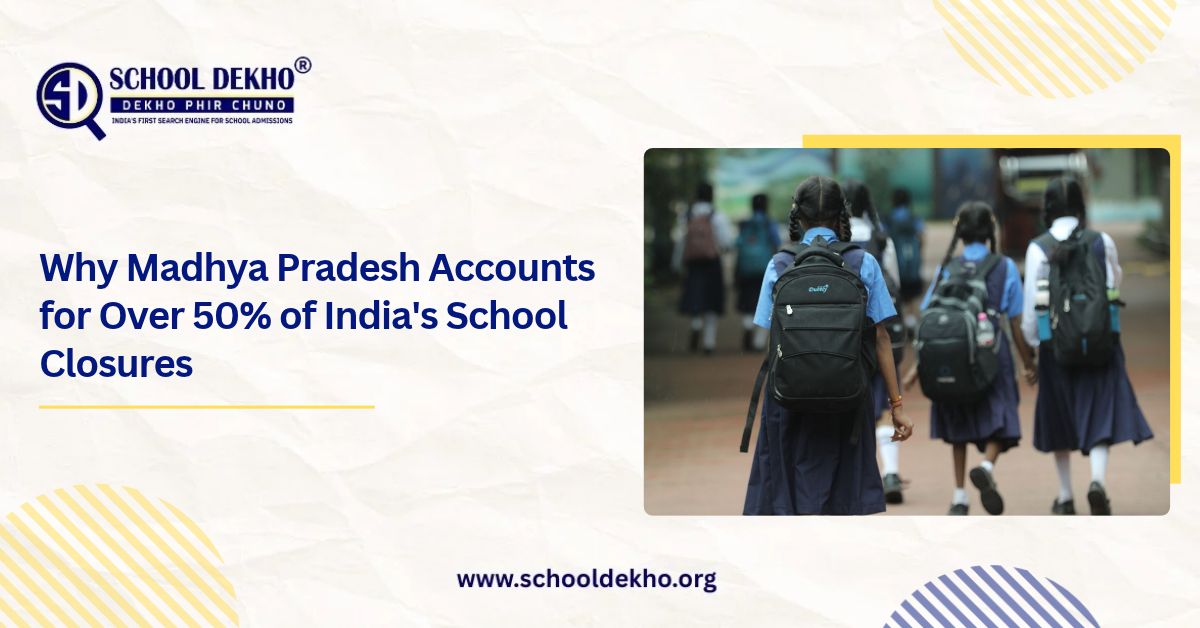
India lost an average of 13 schools every day during the 2025–26 academic year. And more than half of those closures happened in just one state: Madhya Pradesh.
According to the latest Unified District Information System for Education Plus (UDISE+) data released by the Union Education Ministry, a total of 4,791 schools were either closed or merged across the country in 2025-26. Of these, 2,426 were in Madhya Pradesh — accounting for more than 50 percent of the national total. This makes Madhya Pradesh the single largest contributor to India's shrinking school network.
The national school count fell from 14,71,473 in 2024-25 to 14,66,682 in 2025-26. While some states like Bihar (+946), Chhattisgarh (+234), and Delhi (+87) actually added schools, Madhya Pradesh's numbers tell a very different story.
What makes this particularly striking is the timing. Madhya Pradesh's school education budget has climbed to ₹36,730 crore — nearly ₹9,000 crore higher than in 2022-23. More money is being spent on education than ever before, yet schools are closing at an unprecedented rate. How is that possible?
The Policy Behind the Numbers: NITI Aayog's SATH-E Experiment
The answer lies in a massive policy experiment that has turned Madhya Pradesh into the primary laboratory for "school rationalisation" in India.
Under NITI Aayog's Sustainable Action for Transforming Human Capital in Education (SATH-E) project, Madhya Pradesh undertook one of the most aggressive school consolidation drives in the country's history. The state merged nearly 35,000 sub-scale schools into roughly 16,000 same-campus composite schools by integrating primary, middle, and high schools. In the first phase alone, the state consolidated 36,000 schools into approximately 16,000 integrated campuses.
What the Policy Was Meant to Achieve
On paper, the logic is compelling. India has long struggled with a proliferation of single-teacher schools — institutions where one educator is responsible for teaching multiple grades across different subjects. The number of single-teacher schools fell from 1,04,125 in 2024-25 to 1,00,843 in 2025-26, marking the first decline in years.
The administrative gains were immediate: the availability of dedicated principals in merged schools shot up to 55% from a meagre 20%. By pooling resources, the state deployed subject-specific educators more effectively and provided infrastructure — smart classrooms, functional laboratories, libraries, and sports grounds — that smaller schools with fewer than 20 students could never afford.
The state also launched the 'One Campus, One School' (Ek Parisar, Ek Shala) initiative, consolidating 16,076 schools. The Sandipani Vidyalaya scheme (formerly CM Rise Schools) aims to establish fully-equipped schools every 15 kilometres. Two phases of this plan will see 773 Sandipani schools built at a cost of ₹24,915 crore, with a target to enrol nearly 8.5 lakh students. The state has already approved 200 fully-equipped schools at an estimated cost of ₹3,660 crore.
"The metric of success for India's educational policy should not be how many under-enrolled buildings were closed to balance a budget, but whether every single child retains their constitutional right to accessible, free, and quality education." — The Wire
The Ground Reality: When Policy Meets Rural Geography
But as the numbers reveal, the real-world execution of this policy has created a severe stress test for socio-economic equity. When bureaucratic logic collides with rural geography, the consequences for the most vulnerable children can be devastating.
The Morena Case: A Village School Shut Mid-Session
In Narayan Pura, Morena district, a government primary school that had served the community for over two decades was shut down in August 2025 — midway through the academic year. The school served about 20 students, mostly from OBC backgrounds, and had two teachers.
It was merged with the Sandipani School in Sabalgarh, a town located three to four kilometres away.
The result? With no transport facility and young children unable to walk such distances, re-enrolment plummeted. Of the 20 students, only four now attend the new campus. Some enrolled in private schools that offer bus services — an impossible expense for many — while others simply stopped attending school altogether.
And here's the kicker: the old school building wasn't dilapidated. It remains "locked and lying unused" despite being in good condition. A functioning school was closed, its students scattered, its building abandoned — all while education spending reached record highs.
The Dhar Crisis: 500 Girls at Risk of Dropping Out
In Dhar district, parents of nearly 500 girls studying at Government Girls' Higher Secondary School No 4 have warned they will stop sending their daughters to school if the institution is merged with Sandipani Boys' School.
The parents chose this school precisely because it was for girls only. With the merger, their daughters would have to study alongside boys — something many families said they "cannot accept".
Several parents said clearly that they would rather pull their daughters out of school completely than let them attend classes with boys.
There is no other girls' higher secondary school nearby. For hundreds of young women, especially those from rural villages around Dhar, this merger could mean the end of formal education.
Parents also pointed out a critical legal issue: rules allow only schools with fewer than 100 students to be merged, yet this school has around 500. On Wednesday, parents submitted a memorandum to the district collector, demanding the merger be cancelled.
Gen Alpha Takes to the Streets
The protests aren't limited to parents. Schoolchildren — described as Gen Alpha — have staged protests across Madhya Pradesh against proposed school mergers and longer travel distances. Students in 11 districts have reportedly taken to the streets.
Key flashpoints include:
- Katni: A primary and middle school in Supeli village was merged with Sandipani School seven kilometres away, with the route passing through dense forest.
- Sagar's Bina block: Students from Tribal and rural areas protested the proposed merger of 13 primary schools with Sandipani and other schools, demanding that the schools continue operating as before.
- Dindori: Students protested relocation to a new building four kilometres away.
- Sehore: Students and parents opposed the merger of a Government Primary School with Sardar Patel School, located more than two kilometres away.
Students also raised concerns over waterlogging, poor-quality mess food, teacher transfers, and administrative decisions. In Guna, students opposed the removal of their principal. In Chhindwara, students protested mess food quality, alleging insects had repeatedly been found in meals.
The RTE Act Question: Is This Legal?
The Right to Education (RTE) Act, 2009, guarantees free and compulsory education for all children aged six to 14 years and ensures that every child has access to a neighbourhood school.
The norms prescribe one kilometre for Classes I–V and three kilometres for Classes VI–VIII. Madhya Pradesh's own rules, adopted in 2011, require schools to be located within the village or adjoining villages for primary classes, and within three kilometres for upper primary. The rules also provide for free transportation or residential facilities where children live in areas without a school within the prescribed limits.
Yet in Morena, schools located beyond three kilometres were merged without providing transportation or residential facilities.
Former Professor Arun C. Mehta and universal education campaigners have pointed out that across India, the exercise of rationalising, grouping, or merging schools is often being carried out without proper school mapping — a key planning tool used to identify ideal locations for schools and ensure equitable access for all children.
The Madhya Pradesh High Court has also weighed in. In June 2026, the court held that merging schools beyond 2 kilometres violates state policy directives. The state government had issued a policy directive on August 1, 2025, restricting mergers to schools within 2 kilometres of Sandipani Schools. Yet mergers beyond this limit continue.
Zero-Enrolment Schools: A Paradox of Resources
The UDISE+ data also revealed a troubling paradox. For the first time, the number of zero-enrolment schools (schools with no students) declined — from 7,993 to 5,663.
But here's the catch: Despite having no students, these 5,663 schools employ 20,667 teachers. In West Bengal, zero-enrolment schools increased to 4,133 with 19,502 teachers. In Uttar Pradesh, such schools rose from 81 to 313. Chhattisgarh, which had none in 2024-25, reported 149 in 2025-26 with 140 teachers posted there.
Meanwhile, student enrolment fell by 4,37,037 in Bihar, 49,459 in Chhattisgarh, and 45,250 in Delhi — even as these states added schools.
The Larger Picture: India's Disappearing Schools
This isn't just a Madhya Pradesh problem — though the state is undeniably at the epicentre.
A comprehensive NITI Aayog policy report revealed that the number of government schools in India declined from 11.07 lakh to 10.13 lakh over a ten-year assessment period. Nearly 94,000 public schools have disappeared from the education landscape.
Beyond Madhya Pradesh's 2,426 closures, the other states with the highest numbers include:
- Telangana: 1,392 schools
- West Bengal: 568 schools
- Andhra Pradesh: 474 schools
- Tamil Nadu: 369 schools
- Karnataka: 281 schools
Madhya Pradesh's government schools fell from 1.22 lakh in 2018-19 to 99,411 the very next year — a drop of roughly 22,600 in twelve months. In 2024-25, more than 5,500 schools in the state reported zero enrolment in Class 1.
The Distance Barrier: When Access Becomes the Enemy of Education
The most alarming fallout of this consolidation is the risk of rising dropout rates, particularly among adolescent girls.
Data shows that while India's Gross Enrollment Ratio (GER) is nearly universal at the primary stage (over 90%), it drops precipitously to 58.4% at the higher secondary stage.
Why does this matter for school closures?
In rural India, a neighbourhood school is a social anchor. When it closes, the physical distance to the nearest cluster hub increases. Without institutionalised, safe, and free public transit, the burden of commuting falls heavily on marginalised families.
Safety concerns on lonely rural roads often force parents to withdraw daughters from education once the local school disappears. Closing local schools directly worsens the secondary-stage dropout crisis, turning distance into a tool of exclusion.
Budget vs Reality: Where Is the Money Going?
The contrast is stark. Madhya Pradesh's school education budget has grown from ₹6,374 crore in 2010-11 to ₹36,581 crore in 2025-26 — an increase of 57.4%. The 2026-27 budget allocation for school education stands at ₹36,370 crore.
Yet schools are closing faster than ever. The ₹24,915 crore Sandipani plan is building 773 elite schools, but at what cost to the thousands of smaller schools being shuttered?
A government official in the Education Ministry's Department of School Education said the decline is "mainly due to the merger of schools in several states". But the question remains: Is consolidation serving the children, or is it serving administrative convenience?
Looking Ahead: 7,000 More Schools to Close?
The consolidation isn't slowing down. According to reports, approximately 7,000 more schools are expected to close or be merged in Madhya Pradesh over the next five years. Students from these schools are expected to be shifted to nearby Sandipani schools.
The question facing policymakers, educators, and families is this: How do you balance the undeniable benefits of better-resourced, better-staffed schools against the very real risk of excluding the most vulnerable children from education altogether?
As one analysis put it: "The metric of success for India's educational policy should not be how many under-enrolled buildings were closed to balance a budget, but whether every single child retains their constitutional right to accessible, free, and quality education".
The numbers from Madhya Pradesh suggest that while the budget has grown and the buildings have been consolidated, the question of whether every child can actually access quality education remains very much unanswered.
Related Posts
-
12 Ways to Increase Admissions in School (A 2027 Guide)
09 Oct-2026, 03:51 PM -

Can You Take Admission in Class 12 in Another School in India?
09 Oct-2026, 03:27 PM -
SC Extends CBSE 3rd Language Exemption to Class 6
28 Sep-2026, 10:57 PM -

Who Can Be a Co-Applicant for an Education Loan in India?
14 Sep-2026, 09:46 PM -
AI in Education: A Complete Guide for Students and Parents (2026)
14 Sep-2026, 04:40 PM
Search
Latest Posts
-
12 Ways to Increase Admissions in School (A 2027 Guide)
09 Oct-2026, 03:51 PM -
Can You Take Admission in Class 12 in Another School in India?
09 Oct-2026, 03:27 PM -
SC Extends CBSE 3rd Language Exemption to Class 6
28 Sep-2026, 10:57 PM -
Who Can Be a Co-Applicant for an Education Loan in India?
14 Sep-2026, 09:46 PM -
AI in Education: A Complete Guide for Students and Parents (2026)
14 Sep-2026, 04:40 PM
.webp)
.webp)