

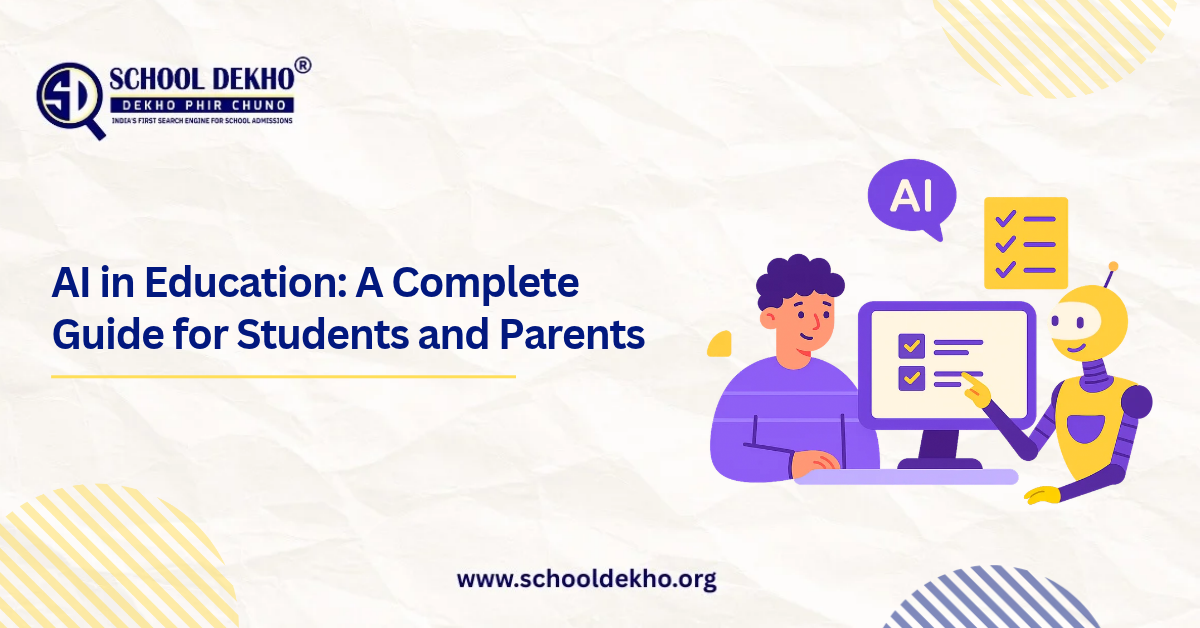
AI in Education: A Complete Guide for Students and Parents (2026)
Artificial intelligence is no longer a future possibility in
education. It is already part of how millions of students study, how teachers
plan lessons, and how schools think about assessment. The question is no longer
whether AI belongs in education, but how it should be used.
Artificial intelligence is no longer a future possibility in
education. It is already part of how millions of students study, how teachers
plan lessons, and how schools think about assessment. The question is no longer
whether AI belongs in education, but how it should be used.
This guide is written for students and parents who want
clear, practical answers. It covers what AI in education actually means, what
the research says, what the risks are, and how to make better decisions about
AI use at home and in school.
What Is AI in Education?
AI in education refers to the use of artificial intelligence
technologies to support teaching, learning, assessment, and educational
administration. This includes a wide range of applications, from generative AI
tools that can explain concepts and provide feedback, to adaptive learning
platforms that adjust content based on student performance, to intelligent
tutoring systems that simulate one-to-one instruction.
It is important to distinguish between different types of AI
in education because they carry different benefits and risks.
Generative AI tools, such as ChatGPT, Google Gemini,
and Microsoft Copilot, produce new content in response to prompts. Students use
them to explain concepts, summarise readings, generate practice questions, and
receive feedback on writing.
Adaptive learning platforms adjust the difficulty and
sequence of learning materials based on how a student is performing. Examples
include Khan Academy's exercise system and various maths and language apps.
Intelligent Tutoring Systems (ITS) attempt to
replicate the experience of a human tutor by diagnosing misunderstandings and
providing targeted instruction. These systems are most developed in subjects
like mathematics and science, where problems have correct answers and reasoning
can be modelled.
Predictive analytics tools analyse student data to
identify those at risk of falling behind, allowing educators to intervene
earlier.
Administrative AI handles tasks like scheduling,
attendance tracking, and initial grading of objective assessments.
Understanding these categories matters because the evidence
for effectiveness varies significantly. Generative AI for explanation and
feedback is supported by a growing body of research, but its effectiveness
depends heavily on how it is used. Adaptive learning platforms show promise,
particularly for lower-performing students, but results are mixed.
How AI Is Being Used in Schools and Universities
Adoption of AI in education has moved rapidly from
experimentation to routine use. According to Microsoft's 2026 AI in Education
Report, 92% of students and education leaders and 88% of educators have already
used AI for school-related purposes. Fifty-eight percent of education leaders
say their schools are already implementing or scaling AI, and 65% of students
report that their AI use for school has increased over the past year.
However, formal training has not kept pace. Seventy-seven
percent of students and 53% of educators say they have not received any formal
AI training, even though 87% of educators and education leaders and 79% of
students agree that knowing how to use AI effectively and responsibly is
important for students' futures.
Academic integrity is a leading concern. Forty-one percent
of students and 42% of educators identify it as a worry, reinforcing the need
for clear, practical guidance on when and how AI should be used.
In India, the Central Board of Secondary Education (CBSE)
launched a Computational Thinking and Artificial Intelligence curriculum for
Classes 3 to 8, implemented from the 2026-27 academic session. The initiative,
themed "AI for Education, AI in Education," aims to develop AI-ready
learners by focusing on computational thinking skills such as logical thinking,
problem solving, and pattern recognition. Board-level assessments in AI are
expected by 2029.
In the United Kingdom, the government has announced stronger
safety measures around AI in education and is investing in EdTech testbeds to
trial AI tools in real classroom settings. The UK is also developing a plan to
provide AI tutoring tools to 450,000 disadvantaged secondary school children by
the end of 2027.
In the United States, the LIFT AI Act and the NSF AI
Education Act of 2026 aim to promote AI literacy at K-12 level, fund teacher
training, and develop age-appropriate AI learning materials.
What the Research Says About AI and Learning
The research on AI in education is growing but still
developing. Several systematic reviews have examined the evidence.
A 2025 systematic review published in European
Educational Researcher found that generative AI has transformative
potential for education by enabling personalised and efficient learning, but
also raises ethical and equity concerns including risks to academic integrity,
data privacy, and algorithmic bias. The review noted that GenAI aligns with
pedagogical theories that promote student autonomy, active learning, and
collaboration, but only when implemented with clear educational intent.
Research on AI-based tutoring in mathematics education
indicates that AI tutoring systems and adaptive learning platforms generally
support improvements in mathematics achievement, particularly among
lower-performing learners, although effectiveness varies depending on
implementation fidelity and learner characteristics.
A systematic review of AI-driven intelligent tutoring
systems in K-12 education found that effects on learning and performance are
generally positive but are mitigated when compared to non-intelligent tutoring
systems.
One case study on personal AI tutors found that active
engagement led to an average improvement of up to 15 percentile points compared
to a parallel course without AI tutoring.
The honest summary is this: AI can support learning,
particularly when it is used to provide additional practice, immediate
feedback, and explanations tailored to a student's level. But it is not a
replacement for good teaching, and its benefits depend on how thoughtfully it
is integrated into learning.
AI Tools for Students: A Practical Guide
The market for AI study tools has expanded rapidly. The
following table categorises the most widely used tools by function, with notes
on their typical use cases and limitations.
|
Tool Category |
Examples |
Primary Use |
Strengths |
Limitations |
|
Conversational AI |
ChatGPT, Google Gemini, Microsoft Copilot, Claude |
Explaining concepts, generating practice questions,
summarising |
Flexible, fast, available in free tiers |
Can produce inaccurate information, requires verification |
|
AI Tutors |
Khanmigo, Scrimba Explain |
Guided practice, Socratic questioning |
Designed for learning rather than answer-giving |
Limited subject coverage, often requires subscription |
|
Adaptive Learning |
Khan Academy, Duolingo |
Personalised practice in maths and languages |
Adjusts to student level, tracks progress |
Less effective for open-ended subjects |
|
Writing Assistants |
Grammarly, Notion AI |
Grammar, style, structure feedback |
Improves clarity and correctness |
Can mask underlying writing weaknesses |
|
Research Tools |
Perplexity, Elicit |
Finding and summarising sources |
Speeds up research, surfaces relevant sources |
Citations can be inaccurate, requires verification |
|
Study Organisation |
Notion AI, Quizlet |
Note-taking, flashcards, revision |
Integrates with study workflows |
AI features often require paid tiers |
In 2026, Google introduced new AI study tools across Search
and Gemini, including interactive visuals, customised practice quizzes, and
dedicated notebooks. Students can now generate custom simulations in Search to
understand complex topics, and practice quizzes are available globally in
English free of charge. Google Lens will also gain a learning tool that lets
students photograph a question and receive explanations and coaching.
A note on free vs. paid tools: Many AI tools offer
free tiers with usage limits. Free tiers are often sufficient for occasional
use, but students who rely heavily on AI for study may encounter limits.
Parents should be aware of what data free tools collect and how it is used.
AI Tutors: What They Can and Cannot Do
AI tutors are among the most discussed applications of AI in
education. They promise personalised, one-to-one instruction at a fraction of
the cost of human tutoring. The reality is more nuanced.
What AI tutors can do well:
- Provide
immediate feedback on practice problems
- Explain
concepts in multiple ways until a student understands
- Generate
unlimited practice questions at varying difficulty levels
- Offer
24/7 availability
- Reduce
anxiety for students who are reluctant to ask questions in class
What AI tutors cannot do well:
- Understand
a student's emotional state or motivation
- Adapt
to non-academic barriers to learning
- Provide
the relational support that human tutors offer
- Reliably
assess open-ended work like essays or projects
- Replace
the judgment of an experienced teacher
Khanmigo, Khan Academy's AI tutor, illustrates both the
promise and the limitations. It is designed to guide students Socratically
rather than give answers directly, which is pedagogically sound but can
frustrate students who want quick answers. Reviews note that it is
"deliberately frustrating for answer-seekers" and that student
engagement is a significant challenge.
The lesson is that AI tutors work best when they are
embedded in a broader learning environment with teacher oversight and clear
expectations. They are a supplement to, not a replacement for, good teaching.
Benefits of AI in Education
Personalised learning at scale. AI can adapt content
and pacing to individual student needs in ways that a single teacher managing
thirty students cannot. This is particularly valuable for students who are
ahead or behind the class average.
Immediate feedback. AI tools can provide instant
feedback on practice problems, allowing students to correct misunderstandings
before they become entrenched.
Reduced teacher workload. AI can assist with lesson
planning, generating practice materials, and initial grading, freeing teachers
to focus on instruction and student support. Microsoft's 2026 report notes that
educators are embracing AI as a classroom ally and asking "not if, but how
to make the most of it".
Accessibility. AI can provide text-to-speech,
translation, and other accessibility features that support diverse learners,
including students with disabilities and English language learners.
Scalable tutoring. AI tutoring tools have the
potential to provide additional support to students who cannot afford private
tutoring, potentially reducing educational inequality. The UK government's plan
to provide AI tutoring to 450,000 disadvantaged pupils is based on this
premise.
Risks and Limitations of AI in Education
Academic integrity. The most immediate concern for
schools is students using generative AI to complete work without genuinely
engaging with the material. Forty-one percent of students and 42% of educators
identify academic integrity as a leading worry. Research on academic integrity
in the age of generative AI notes that students are navigating an "ethical
grey zone" as they struggle to understand where the line between
assistance and dishonesty lies.
Over-reliance and skill atrophy. If students use AI
to generate answers rather than to support their own thinking, they may fail to
develop the critical thinking, writing, and problem-solving skills that
education is designed to build. Pre-service teachers have expressed concerns
that over-reliance on AI could undermine teacher-student interactions and
student learning.
Inaccurate and fabricated outputs. Generative AI
tools can produce confident-sounding but incorrect information. They do not
understand truth; they predict likely sequences of words. This means students
must learn to verify AI outputs rather than accept them uncritically.
Data privacy. AI tools collect data. When students
use these tools, their data may be stored, analysed, or shared. Parents and
schools need to understand what data is being collected and how it is
protected.
Algorithmic bias. AI models can perpetuate and
amplify biases present in their training data. Research has documented concerns
about biased content, including Eurocentric outputs and negative stereotypes
about Black children.
Digital divide. Not all students have equal access to
devices, internet connectivity, or the digital literacy to use AI tools
effectively. Without deliberate efforts to ensure equitable access, AI could
widen existing educational inequalities.
Teacher training gap. The majority of educators have
not received formal AI training. Seventy-seven percent of students and 53% of
educators report no formal AI training. Without adequate support, teachers
cannot effectively guide students in responsible AI use.
Academic Integrity in the Age of AI
Academic integrity is not a new concern, but generative AI
has made it more complex. The traditional model of detecting plagiarism through
similarity-matching tools does not work for AI-generated content, which is
original in the sense that it is newly generated.
AI detection tools exist but are unreliable. They produce
false positives and false negatives, and there is no tool that can definitively
determine whether a piece of writing was produced by a human or an AI. Schools
and universities are increasingly moving away from detection-based approaches
towards assessment redesign and AI literacy.
Research on educational integrity in GenAI-augmented
assessment suggests a shift from "detection-based compliance models to
structurally embedded assessment design". In practice, this means
designing assessments that require process over final answers, such as in-class
writing, oral examinations, and project-based work with documented stages.
For students, the practical guidance is:
- Understand
your school's policy. Rules vary between institutions and even between
teachers. Do not assume that what is allowed in one context is allowed in
another.
- Use
AI for learning, not for producing work you submit as your own. Using
AI to understand a concept, generate practice questions, or get feedback
on a draft is different from asking AI to write an essay for you.
- Be
transparent. If you use AI in your work, cite it appropriately. Many
academic styles now have conventions for citing AI assistance.
- Keep
your own voice. AI should support your thinking, not replace it. If
you cannot explain or defend what you have submitted, you have likely
relied too heavily on AI.
For parents, the practical guidance is:
- Ask
what the school's policy is and make sure your child understands it.
- Talk
about the difference between AI as a learning tool and AI as a shortcut.
The distinction is not always obvious to students.
- Focus
on process, not just output. Ask your child to explain their thinking,
not just show you the finished work.
- Avoid
relying on AI detection tools to determine whether your child has
cheated. They are not reliable and can damage trust.
AI Literacy: What Every Student Should Know
AI literacy is the set of knowledge, skills, and attitudes
that enable a person to use AI effectively, critically, and responsibly.
Several frameworks have been developed to define AI literacy for students.
The AILit Framework, developed by the OECD and the European
Commission with international experts, organises AI literacy across four
domains: Engage with AI, Create with AI, Manage AI, and Shape AI. These domains
cover awareness, creative use, responsible decision-making, and understanding
how AI systems are shaped by human values.
UNESCO published an AI Competency Framework for Students in
February 2025, with twelve competency blocks across four interdependent
aspects, organised into three levels: understand, apply, and create. The
framework emphasises a human-centred approach to AI, critical awareness of AI's
benefits and limitations, and understanding of AI's environmental impact.
In practical terms, an AI-literate student should be able
to:
- Explain
what AI is and what it is not
- Identify
when AI is being used in tools they encounter
- Use
AI tools effectively for learning tasks
- Evaluate
the accuracy and reliability of AI outputs
- Understand
the ethical implications of AI use
- Make
informed decisions about when to use AI and when not to
- Protect
their privacy and data when using AI tools
- Recognise
and respond to AI-generated misinformation
A Guide for Parents: How to Support Your Child
Research from Brookings notes that parents often feel
unsupported in navigating their children's AI use. Many parents have not had
the opportunity to understand what AI is, how it works, and how it affects
their children. In the United States, 91% of children aged 13 to 17 use
generative AI in their personal lives, and 72% have used AI companions.
Practical steps for parents:
1. Learn alongside your child. You do not need to be
an AI expert. Start by asking your child to show you what they use AI for.
Explore a tool together and ask questions. The goal is to open a conversation,
not to conduct an audit.
2. Prioritise safety and privacy. Make sure your
child understands that anything shared with a public AI tool may be stored and
used. Encourage them not to share personal information, addresses, financial
details, or anything they would not want to be public. Be cautious about AI
tools that are free; often, the user's data is the product.
3. Discuss academic integrity. Learn your child's
school policy on AI use and make sure they understand it. Talk about the
difference between using AI to learn and using AI to avoid learning. Help them
understand that passing off AI-generated work as their own cheats them of the
learning process.
4. Apply critical thinking together. Help your child
see that AI tools often get things wrong, even when the answer sounds
convincing. AI works by solving complex statistical problems; it cannot
generate new ideas and often presents outdated or factually incorrect
information. It also struggles to understand context, background information,
relationships, and ethics.
5. Create a positive mindset. Encourage your child to
come home from school and discuss what they have learned about AI. This helps
create meaningful conversations and builds healthy relationships with the
technology.
6. Set boundaries. Discuss when and where AI use is
appropriate. Consider whether AI use should be allowed during homework time, in
what subjects, and with what level of teacher awareness.
7. Remember what it means to be human. AI can support
learning, but it cannot replace human judgment, care, or relationships. Help
your child understand that their own thinking, creativity, and effort are what
matter most.
Questions parents can ask their child's school:
- What
is your policy on AI use in the classroom and for homework?
- How
are you teaching students to use AI responsibly?
- What
AI tools are being used in the school, and how were they selected?
- How
do you ensure assessments remain fair and meaningful in the age of AI?
- What
support is available for students who struggle with digital literacy?
- How
are you addressing data privacy and security concerns?
What Schools and Governments Are Doing
India: The CBSE curriculum on Computational Thinking
and AI for Classes 3 to 8 was launched in April 2026 and implemented from the
2026-27 academic session. The curriculum includes structured modules, teacher
handbooks, and student assessment frameworks. The vision for integrating AI
into school curricula is not limited to CBSE-affiliated schools. Separately,
Google has announced a nationwide AI literacy initiative in India in
partnership with UNICEF and state governments, focused on teacher training and
responsible AI use.
United Kingdom: The UK government has updated safety
standards for AI in schools and is investing £23 million in EdTech testbeds to
trial AI tools in real classroom settings. The government plans to provide AI
tutoring tools to 450,000 disadvantaged secondary school children by the end of
2027. MPs have also launched an inquiry into the role of AI and EdTech in
education.
United States: The LIFT AI Act and NSF AI Education
Act of 2026 authorise the National Science Foundation to support programmes
that promote AI literacy for K-12 students and educators, fund the development
of age-appropriate AI learning materials, and provide teacher training. The
Secretary of Education has also issued a supplemental priority on advancing AI
in education.
International: UNESCO published AI competency
frameworks for students and teachers in 2025, providing guidance for public
education systems to develop the skills required for effective AI use. The
AILit Framework, developed by the OECD and European Commission, was finalised
in June 2026 and provides classroom-ready guidance for AI literacy across
primary and secondary education.
The Future of AI in Education
Predicting the future of AI in education is difficult
because the technology is changing rapidly and its long-term effects are not
yet known. However, some trends are clear.
AI will become more integrated into existing tools. Rather
than students using separate AI tools, AI features are being embedded into the
platforms they already use, such as Google Workspace, Microsoft 365, and
learning management systems.
The focus will shift from adoption to implementation
quality. As the initial novelty of AI wears off, the question will become
how to use it well. This means investing in teacher training, developing clear
policies, and evaluating what actually works.
AI literacy will become a core competency. Just as
digital literacy became essential in the early 2000s, AI literacy is becoming
essential now. Students will need to understand not only how to use AI tools
but also their limitations, ethical implications, and appropriate boundaries.
The human element will matter more, not less. As AI
takes over routine tasks, the value of human skills such as critical thinking,
creativity, collaboration, and ethical judgment will increase. The goal of
education in an AI world is not to compete with AI but to develop the
distinctly human capacities that AI cannot replicate.
17. FAQ SECTION
What is AI in education?
AI in education refers to the use of artificial intelligence
tools and systems to support teaching, learning, assessment, and educational
administration. This includes generative AI tools like ChatGPT, adaptive
learning platforms, intelligent tutoring systems, and predictive analytics
tools.
Is AI good or bad for education?
AI is neither inherently good nor bad. It can support
learning by providing personalised practice, immediate feedback, and
explanations at a student's level. However, it also carries risks including
academic dishonesty, over-reliance, data privacy concerns, and algorithmic
bias. The outcome depends on how thoughtfully AI is integrated into learning.
How can students use AI responsibly?
Students can use AI responsibly by understanding their
school's policy, using AI for learning rather than producing work they submit
as their own, verifying AI outputs for accuracy, citing AI assistance
appropriately, and ensuring they can explain and defend their own thinking.
What should parents know about AI in education?
Parents should understand what AI tools their children are
using, discuss academic integrity and privacy, help their children think
critically about AI outputs, and engage with their child's school about AI
policies. Research shows that many parents feel unsupported in navigating their
children's AI use.
Can AI replace teachers?
No. AI can assist with certain tasks such as generating
practice materials and providing initial feedback, but it cannot replicate the
relational, emotional, and contextual understanding that teachers bring. AI
works best as a supplement to, not a replacement for, good teaching.
What is the difference between AI as a tutor and AI as a
tool?
An AI tutor is designed specifically to guide learning
through questioning and explanation, often with a pedagogical framework. An AI
tool is a more general-purpose system that can be used for many tasks. AI
tutors like Khanmigo are deliberately designed to be less convenient for
answer-seeking, while general tools like ChatGPT will provide direct answers.
Are AI detection tools reliable?
No. AI detection tools produce false positives and false
negatives, and there is no tool that can definitively determine whether writing
was produced by a human or an AI. Schools are increasingly moving away from
detection-based approaches towards assessment redesign and AI literacy.
What is AI literacy?
AI literacy is the set of knowledge, skills, and attitudes
that enable a person to use AI effectively, critically, and responsibly. It
includes understanding what AI is, evaluating AI outputs, recognising ethical
implications, and making informed decisions about when and how to use AI.
How is AI being used in Indian schools?
The CBSE has introduced a Computational Thinking and AI
curriculum for Classes 3 to 8 from the 2026-27 academic session. The curriculum
focuses on developing computational thinking skills such as logical thinking,
problem solving, and pattern recognition. Google has also launched a nationwide
AI literacy initiative in partnership with UNICEF and state governments.
What should I do if my child is using AI to cheat?
First, talk to your child about what happened without being
accusatory. Help them understand why using AI to produce work they submit as
their own is harmful to their learning. Review the school's policy together.
Focus on the process of learning, not just the output. Avoid relying on AI
detection tools, which are unreliable.
Will AI make learning easier or harder?
AI can make certain aspects of learning easier by providing
quick access to explanations and feedback. But it can also make learning harder
if students become dependent on it and fail to develop their own thinking
skills. The goal is to use AI in ways that support, rather than replace,
genuine learning.
What AI tools are best for studying?
The best AI tool depends on the subject and the learning
goal. Conversational AI tools like ChatGPT and Gemini are flexible and useful
for explanations and practice questions. AI tutors like Khanmigo are designed
specifically for guided learning. Adaptive platforms like Khan Academy are
effective for maths and language practice. Writing assistants like Grammarly
can help with clarity and correctness.
What Is AI in Education?
AI in education refers to the use of artificial intelligence
technologies to support teaching, learning, assessment, and educational
administration. This includes a wide range of applications, from generative AI
tools that can explain concepts and provide feedback, to adaptive learning
platforms that adjust content based on student performance, to intelligent
tutoring systems that simulate one-to-one instruction.
It is important to distinguish between different types of AI
in education because they carry different benefits and risks.
Generative AI tools, such as ChatGPT, Google Gemini,
and Microsoft Copilot, produce new content in response to prompts. Students use
them to explain concepts, summarise readings, generate practice questions, and
receive feedback on writing.
Adaptive learning platforms adjust the difficulty and
sequence of learning materials based on how a student is performing. Examples
include Khan Academy's exercise system and various maths and language apps.
Intelligent Tutoring Systems (ITS) attempt to
replicate the experience of a human tutor by diagnosing misunderstandings and
providing targeted instruction. These systems are most developed in subjects
like mathematics and science, where problems have correct answers and reasoning
can be modelled.
Predictive analytics tools analyse student data to
identify those at risk of falling behind, allowing educators to intervene
earlier.
Administrative AI handles tasks like scheduling,
attendance tracking, and initial grading of objective assessments.
Understanding these categories matters because the evidence
for effectiveness varies significantly. Generative AI for explanation and
feedback is supported by a growing body of research, but its effectiveness
depends heavily on how it is used. Adaptive learning platforms show promise,
particularly for lower-performing students, but results are mixed.
How AI Is Being Used in Schools and Universities
Adoption of AI in education has moved rapidly from
experimentation to routine use. According to Microsoft's 2026 AI in Education
Report, 92% of students and education leaders and 88% of educators have already
used AI for school-related purposes. Fifty-eight percent of education leaders
say their schools are already implementing or scaling AI, and 65% of students
report that their AI use for school has increased over the past year.
However, formal training has not kept pace. Seventy-seven
percent of students and 53% of educators say they have not received any formal
AI training, even though 87% of educators and education leaders and 79% of
students agree that knowing how to use AI effectively and responsibly is
important for students' futures.
Academic integrity is a leading concern. Forty-one percent
of students and 42% of educators identify it as a worry, reinforcing the need
for clear, practical guidance on when and how AI should be used.
In India, the Central Board of Secondary Education (CBSE)
launched a Computational Thinking and Artificial Intelligence curriculum for
Classes 3 to 8, implemented from the 2026-27 academic session. The initiative,
themed "AI for Education, AI in Education," aims to develop AI-ready
learners by focusing on computational thinking skills such as logical thinking,
problem solving, and pattern recognition. Board-level assessments in AI are
expected by 2029.
In the United Kingdom, the government has announced stronger
safety measures around AI in education and is investing in EdTech testbeds to
trial AI tools in real classroom settings. The UK is also developing a plan to
provide AI tutoring tools to 450,000 disadvantaged secondary school children by
the end of 2027.
In the United States, the LIFT AI Act and the NSF AI
Education Act of 2026 aim to promote AI literacy at K-12 level, fund teacher
training, and develop age-appropriate AI learning materials.
What the Research Says About AI and Learning
The research on AI in education is growing but still
developing. Several systematic reviews have examined the evidence.
A 2025 systematic review published in European
Educational Researcher found that generative AI has transformative
potential for education by enabling personalised and efficient learning, but
also raises ethical and equity concerns including risks to academic integrity,
data privacy, and algorithmic bias. The review noted that GenAI aligns with
pedagogical theories that promote student autonomy, active learning, and
collaboration, but only when implemented with clear educational intent.
Research on AI-based tutoring in mathematics education
indicates that AI tutoring systems and adaptive learning platforms generally
support improvements in mathematics achievement, particularly among
lower-performing learners, although effectiveness varies depending on
implementation fidelity and learner characteristics.
A systematic review of AI-driven intelligent tutoring
systems in K-12 education found that effects on learning and performance are
generally positive but are mitigated when compared to non-intelligent tutoring
systems.
One case study on personal AI tutors found that active
engagement led to an average improvement of up to 15 percentile points compared
to a parallel course without AI tutoring.
The honest summary is this: AI can support learning,
particularly when it is used to provide additional practice, immediate
feedback, and explanations tailored to a student's level. But it is not a
replacement for good teaching, and its benefits depend on how thoughtfully it
is integrated into learning.
AI Tools for Students: A Practical Guide
The market for AI study tools has expanded rapidly. The
following table categorises the most widely used tools by function, with notes
on their typical use cases and limitations.
|
Tool Category |
Examples |
Primary Use |
Strengths |
Limitations |
|
Conversational AI |
ChatGPT, Google Gemini, Microsoft Copilot, Claude |
Explaining concepts, generating practice questions,
summarising |
Flexible, fast, available in free tiers |
Can produce inaccurate information, requires verification |
|
AI Tutors |
Khanmigo, Scrimba Explain |
Guided practice, Socratic questioning |
Designed for learning rather than answer-giving |
Limited subject coverage, often requires subscription |
|
Adaptive Learning |
Khan Academy, Duolingo |
Personalised practice in maths and languages |
Adjusts to student level, tracks progress |
Less effective for open-ended subjects |
|
Writing Assistants |
Grammarly, Notion AI |
Grammar, style, structure feedback |
Improves clarity and correctness |
Can mask underlying writing weaknesses |
|
Research Tools |
Perplexity, Elicit |
Finding and summarising sources |
Speeds up research, surfaces relevant sources |
Citations can be inaccurate, requires verification |
|
Study Organisation |
Notion AI, Quizlet |
Note-taking, flashcards, revision |
Integrates with study workflows |
AI features often require paid tiers |
In 2026, Google introduced new AI study tools across Search
and Gemini, including interactive visuals, customised practice quizzes, and
dedicated notebooks. Students can now generate custom simulations in Search to
understand complex topics, and practice quizzes are available globally in
English free of charge. Google Lens will also gain a learning tool that lets
students photograph a question and receive explanations and coaching.
A note on free vs. paid tools: Many AI tools offer
free tiers with usage limits. Free tiers are often sufficient for occasional
use, but students who rely heavily on AI for study may encounter limits.
Parents should be aware of what data free tools collect and how it is used.
AI Tutors: What They Can and Cannot Do
AI tutors are among the most discussed applications of AI in
education. They promise personalised, one-to-one instruction at a fraction of
the cost of human tutoring. The reality is more nuanced.
What AI tutors can do well:
- Provide
immediate feedback on practice problems
- Explain
concepts in multiple ways until a student understands
- Generate
unlimited practice questions at varying difficulty levels
- Offer
24/7 availability
- Reduce
anxiety for students who are reluctant to ask questions in class
What AI tutors cannot do well:
- Understand
a student's emotional state or motivation
- Adapt
to non-academic barriers to learning
- Provide
the relational support that human tutors offer
- Reliably
assess open-ended work like essays or projects
- Replace
the judgment of an experienced teacher
Khanmigo, Khan Academy's AI tutor, illustrates both the
promise and the limitations. It is designed to guide students Socratically
rather than give answers directly, which is pedagogically sound but can
frustrate students who want quick answers. Reviews note that it is
"deliberately frustrating for answer-seekers" and that student
engagement is a significant challenge.
The lesson is that AI tutors work best when they are
embedded in a broader learning environment with teacher oversight and clear
expectations. They are a supplement to, not a replacement for, good teaching.
Benefits of AI in Education
Personalised learning at scale. AI can adapt content
and pacing to individual student needs in ways that a single teacher managing
thirty students cannot. This is particularly valuable for students who are
ahead or behind the class average.
Immediate feedback. AI tools can provide instant
feedback on practice problems, allowing students to correct misunderstandings
before they become entrenched.
Reduced teacher workload. AI can assist with lesson
planning, generating practice materials, and initial grading, freeing teachers
to focus on instruction and student support. Microsoft's 2026 report notes that
educators are embracing AI as a classroom ally and asking "not if, but how
to make the most of it".
Accessibility. AI can provide text-to-speech,
translation, and other accessibility features that support diverse learners,
including students with disabilities and English language learners.
Scalable tutoring. AI tutoring tools have the
potential to provide additional support to students who cannot afford private
tutoring, potentially reducing educational inequality. The UK government's plan
to provide AI tutoring to 450,000 disadvantaged pupils is based on this
premise.
Risks and Limitations of AI in Education
Academic integrity. The most immediate concern for
schools is students using generative AI to complete work without genuinely
engaging with the material. Forty-one percent of students and 42% of educators
identify academic integrity as a leading worry. Research on academic integrity
in the age of generative AI notes that students are navigating an "ethical
grey zone" as they struggle to understand where the line between
assistance and dishonesty lies.
Over-reliance and skill atrophy. If students use AI
to generate answers rather than to support their own thinking, they may fail to
develop the critical thinking, writing, and problem-solving skills that
education is designed to build. Pre-service teachers have expressed concerns
that over-reliance on AI could undermine teacher-student interactions and
student learning.
Inaccurate and fabricated outputs. Generative AI
tools can produce confident-sounding but incorrect information. They do not
understand truth; they predict likely sequences of words. This means students
must learn to verify AI outputs rather than accept them uncritically.
Data privacy. AI tools collect data. When students
use these tools, their data may be stored, analysed, or shared. Parents and
schools need to understand what data is being collected and how it is
protected.
Algorithmic bias. AI models can perpetuate and
amplify biases present in their training data. Research has documented concerns
about biased content, including Eurocentric outputs and negative stereotypes
about Black children.
Digital divide. Not all students have equal access to
devices, internet connectivity, or the digital literacy to use AI tools
effectively. Without deliberate efforts to ensure equitable access, AI could
widen existing educational inequalities.
Teacher training gap. The majority of educators have
not received formal AI training. Seventy-seven percent of students and 53% of
educators report no formal AI training. Without adequate support, teachers
cannot effectively guide students in responsible AI use.
Academic Integrity in the Age of AI
Academic integrity is not a new concern, but generative AI
has made it more complex. The traditional model of detecting plagiarism through
similarity-matching tools does not work for AI-generated content, which is
original in the sense that it is newly generated.
AI detection tools exist but are unreliable. They produce
false positives and false negatives, and there is no tool that can definitively
determine whether a piece of writing was produced by a human or an AI. Schools
and universities are increasingly moving away from detection-based approaches
towards assessment redesign and AI literacy.
Research on educational integrity in GenAI-augmented
assessment suggests a shift from "detection-based compliance models to
structurally embedded assessment design". In practice, this means
designing assessments that require process over final answers, such as in-class
writing, oral examinations, and project-based work with documented stages.
For students, the practical guidance is:
- Understand
your school's policy. Rules vary between institutions and even between
teachers. Do not assume that what is allowed in one context is allowed in
another.
- Use
AI for learning, not for producing work you submit as your own. Using
AI to understand a concept, generate practice questions, or get feedback
on a draft is different from asking AI to write an essay for you.
- Be
transparent. If you use AI in your work, cite it appropriately. Many
academic styles now have conventions for citing AI assistance.
- Keep
your own voice. AI should support your thinking, not replace it. If
you cannot explain or defend what you have submitted, you have likely
relied too heavily on AI.
For parents, the practical guidance is:
- Ask
what the school's policy is and make sure your child understands it.
- Talk
about the difference between AI as a learning tool and AI as a shortcut.
The distinction is not always obvious to students.
- Focus
on process, not just output. Ask your child to explain their thinking,
not just show you the finished work.
- Avoid
relying on AI detection tools to determine whether your child has
cheated. They are not reliable and can damage trust.
AI Literacy: What Every Student Should Know
AI literacy is the set of knowledge, skills, and attitudes
that enable a person to use AI effectively, critically, and responsibly.
Several frameworks have been developed to define AI literacy for students.
The AILit Framework, developed by the OECD and the European
Commission with international experts, organises AI literacy across four
domains: Engage with AI, Create with AI, Manage AI, and Shape AI. These domains
cover awareness, creative use, responsible decision-making, and understanding
how AI systems are shaped by human values.
UNESCO published an AI Competency Framework for Students in
February 2025, with twelve competency blocks across four interdependent
aspects, organised into three levels: understand, apply, and create. The
framework emphasises a human-centred approach to AI, critical awareness of AI's
benefits and limitations, and understanding of AI's environmental impact.
In practical terms, an AI-literate student should be able
to:
- Explain
what AI is and what it is not
- Identify
when AI is being used in tools they encounter
- Use
AI tools effectively for learning tasks
- Evaluate
the accuracy and reliability of AI outputs
- Understand
the ethical implications of AI use
- Make
informed decisions about when to use AI and when not to
- Protect
their privacy and data when using AI tools
- Recognise
and respond to AI-generated misinformation
A Guide for Parents: How to Support Your Child
Research from Brookings notes that parents often feel
unsupported in navigating their children's AI use. Many parents have not had
the opportunity to understand what AI is, how it works, and how it affects
their children. In the United States, 91% of children aged 13 to 17 use
generative AI in their personal lives, and 72% have used AI companions.
Practical steps for parents:
1. Learn alongside your child. You do not need to be
an AI expert. Start by asking your child to show you what they use AI for.
Explore a tool together and ask questions. The goal is to open a conversation,
not to conduct an audit.
2. Prioritise safety and privacy. Make sure your
child understands that anything shared with a public AI tool may be stored and
used. Encourage them not to share personal information, addresses, financial
details, or anything they would not want to be public. Be cautious about AI
tools that are free; often, the user's data is the product.
3. Discuss academic integrity. Learn your child's
school policy on AI use and make sure they understand it. Talk about the
difference between using AI to learn and using AI to avoid learning. Help them
understand that passing off AI-generated work as their own cheats them of the
learning process.
4. Apply critical thinking together. Help your child
see that AI tools often get things wrong, even when the answer sounds
convincing. AI works by solving complex statistical problems; it cannot
generate new ideas and often presents outdated or factually incorrect
information. It also struggles to understand context, background information,
relationships, and ethics.
5. Create a positive mindset. Encourage your child to
come home from school and discuss what they have learned about AI. This helps
create meaningful conversations and builds healthy relationships with the
technology.
6. Set boundaries. Discuss when and where AI use is
appropriate. Consider whether AI use should be allowed during homework time, in
what subjects, and with what level of teacher awareness.
7. Remember what it means to be human. AI can support
learning, but it cannot replace human judgment, care, or relationships. Help
your child understand that their own thinking, creativity, and effort are what
matter most.
Questions parents can ask their child's school:
- What
is your policy on AI use in the classroom and for homework?
- How
are you teaching students to use AI responsibly?
- What
AI tools are being used in the school, and how were they selected?
- How
do you ensure assessments remain fair and meaningful in the age of AI?
- What
support is available for students who struggle with digital literacy?
- How
are you addressing data privacy and security concerns?
What Schools and Governments Are Doing
India: The CBSE curriculum on Computational Thinking
and AI for Classes 3 to 8 was launched in April 2026 and implemented from the
2026-27 academic session. The curriculum includes structured modules, teacher
handbooks, and student assessment frameworks. The vision for integrating AI
into school curricula is not limited to CBSE-affiliated schools. Separately,
Google has announced a nationwide AI literacy initiative in India in
partnership with UNICEF and state governments, focused on teacher training and
responsible AI use.
United Kingdom: The UK government has updated safety
standards for AI in schools and is investing £23 million in EdTech testbeds to
trial AI tools in real classroom settings. The government plans to provide AI
tutoring tools to 450,000 disadvantaged secondary school children by the end of
2027. MPs have also launched an inquiry into the role of AI and EdTech in
education.
United States: The LIFT AI Act and NSF AI Education
Act of 2026 authorise the National Science Foundation to support programmes
that promote AI literacy for K-12 students and educators, fund the development
of age-appropriate AI learning materials, and provide teacher training. The
Secretary of Education has also issued a supplemental priority on advancing AI
in education.
International: UNESCO published AI competency
frameworks for students and teachers in 2025, providing guidance for public
education systems to develop the skills required for effective AI use. The
AILit Framework, developed by the OECD and European Commission, was finalised
in June 2026 and provides classroom-ready guidance for AI literacy across
primary and secondary education.
The Future of AI in Education
Predicting the future of AI in education is difficult
because the technology is changing rapidly and its long-term effects are not
yet known. However, some trends are clear.
AI will become more integrated into existing tools. Rather
than students using separate AI tools, AI features are being embedded into the
platforms they already use, such as Google Workspace, Microsoft 365, and
learning management systems.
The focus will shift from adoption to implementation
quality. As the initial novelty of AI wears off, the question will become
how to use it well. This means investing in teacher training, developing clear
policies, and evaluating what actually works.
AI literacy will become a core competency. Just as
digital literacy became essential in the early 2000s, AI literacy is becoming
essential now. Students will need to understand not only how to use AI tools
but also their limitations, ethical implications, and appropriate boundaries.
The human element will matter more, not less. As AI takes over routine tasks, the value of human skills such as critical thinking, creativity, collaboration, and ethical judgment will increase. The goal of education in an AI world is not to compete with AI but to develop the distinctly human capacities that AI cannot replicate.
FAQ
What is AI in education?
AI in education refers to the use of artificial intelligence
tools and systems to support teaching, learning, assessment, and educational
administration. This includes generative AI tools like ChatGPT, adaptive
learning platforms, intelligent tutoring systems, and predictive analytics
tools.
Is AI good or bad for education?
AI is neither inherently good nor bad. It can support
learning by providing personalised practice, immediate feedback, and
explanations at a student's level. However, it also carries risks including
academic dishonesty, over-reliance, data privacy concerns, and algorithmic
bias. The outcome depends on how thoughtfully AI is integrated into learning.
How can students use AI responsibly?
Students can use AI responsibly by understanding their
school's policy, using AI for learning rather than producing work they submit
as their own, verifying AI outputs for accuracy, citing AI assistance
appropriately, and ensuring they can explain and defend their own thinking.
What should parents know about AI in education?
Parents should understand what AI tools their children are
using, discuss academic integrity and privacy, help their children think
critically about AI outputs, and engage with their child's school about AI
policies. Research shows that many parents feel unsupported in navigating their
children's AI use.
Can AI replace teachers?
No. AI can assist with certain tasks such as generating
practice materials and providing initial feedback, but it cannot replicate the
relational, emotional, and contextual understanding that teachers bring. AI
works best as a supplement to, not a replacement for, good teaching.
What is the difference between AI as a tutor and AI as a
tool?
An AI tutor is designed specifically to guide learning
through questioning and explanation, often with a pedagogical framework. An AI
tool is a more general-purpose system that can be used for many tasks. AI
tutors like Khanmigo are deliberately designed to be less convenient for
answer-seeking, while general tools like ChatGPT will provide direct answers.
Are AI detection tools reliable?
No. AI detection tools produce false positives and false
negatives, and there is no tool that can definitively determine whether writing
was produced by a human or an AI. Schools are increasingly moving away from
detection-based approaches towards assessment redesign and AI literacy.
What is AI literacy?
AI literacy is the set of knowledge, skills, and attitudes
that enable a person to use AI effectively, critically, and responsibly. It
includes understanding what AI is, evaluating AI outputs, recognising ethical
implications, and making informed decisions about when and how to use AI.
How is AI being used in Indian schools?
The CBSE has introduced a Computational Thinking and AI
curriculum for Classes 3 to 8 from the 2026-27 academic session. The curriculum
focuses on developing computational thinking skills such as logical thinking,
problem solving, and pattern recognition. Google has also launched a nationwide
AI literacy initiative in partnership with UNICEF and state governments.
What should I do if my child is using AI to cheat?
First, talk to your child about what happened without being
accusatory. Help them understand why using AI to produce work they submit as
their own is harmful to their learning. Review the school's policy together.
Focus on the process of learning, not just the output. Avoid relying on AI
detection tools, which are unreliable.
Will AI make learning easier or harder?
AI can make certain aspects of learning easier by providing
quick access to explanations and feedback. But it can also make learning harder
if students become dependent on it and fail to develop their own thinking
skills. The goal is to use AI in ways that support, rather than replace,
genuine learning.
What AI tools are best for studying?
The best AI tool depends on the subject and the learning
goal. Conversational AI tools like ChatGPT and Gemini are flexible and useful
for explanations and practice questions. AI tutors like Khanmigo are designed
specifically for guided learning. Adaptive platforms like Khan Academy are
effective for maths and language practice. Writing assistants like Grammarly
can help with clarity and correctness.
Related Posts
-
AI in Education: A Complete Guide for Students and Parents (2026)
14 Sep-2026, 04:40 PM -

Why Madhya Pradesh Accounts for Over 50% of India's School Closures
03 Sep-2026, 04:39 PM -
The Benefits of Maintaining High Cleanliness Standards in Educational Spaces
27 Jul-2026, 03:20 PM -

How Student Entrepreneurs Can Build a Professional Presence Early
30 Jun-2026, 08:10 PM
Search
Latest Posts
-
AI in Education: A Complete Guide for Students and Parents (2026)
14 Sep-2026, 04:40 PM -
Why Madhya Pradesh Accounts for Over 50% of India's School Closures
03 Sep-2026, 04:39 PM -
The Benefits of Maintaining High Cleanliness Standards in Educational Spaces
27 Jul-2026, 03:20 PM -
How Student Entrepreneurs Can Build a Professional Presence Early
30 Jun-2026, 08:10 PM
.webp)
.webp)