

Best Premium Stroller with Car Seat Compatibility in 2026
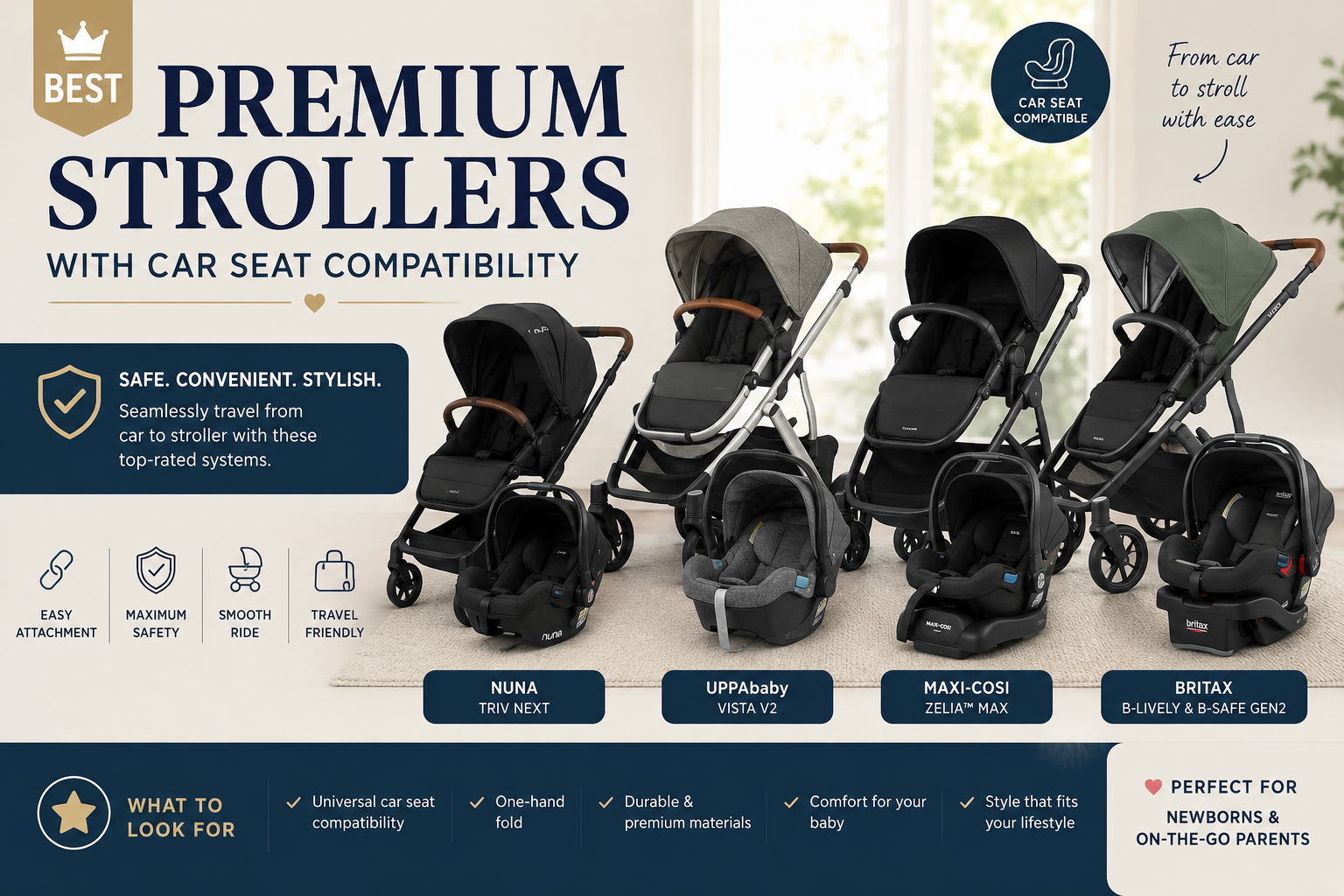
You want your baby gear to work as hard as you do. A
stroller that feels like a luxury vehicle, paired with a car seat that clicks
in without waking a sleeping infant - that is not just a wish list item. For a
growing number of parents, it is the baseline expectation.
The challenge? The premium stroller market has never been
more crowded with features that sound impressive on a product page but can feel
confusing to compare in real life. From all-terrain suspension systems to
one-hand folding mechanisms and adapter-free car seat connections, the
terminology alone can feel like learning a new language.
This guide cuts through the noise. We have pulled together
research from expert reviews, parent feedback, and hands-on testing insights to
help you understand exactly what makes a premium travel system worth the
investment, which configurations lead the pack in 2026, and how to avoid the
most common and expensive mistakes first-time buyers make.
Who This Guide Is For
- Expecting
parents building their first baby registry who want a system that lasts
through the toddler years
- Urban
families who treat their stroller as a primary vehicle and need daily
durability and handling
- Parents
who value safety and engineering and are willing to invest upfront for a
smoother ride and longer life
- Anyone
overwhelmed by the options who wants a clear, comparison-driven breakdown
of the premium tier
What Makes a Stroller and Car Seat Combo Truly "Premium"
Before diving into specific models, it helps to know what
separates a high-end travel system from an entry-level one. The difference is
rarely one single feature; it is usually a combination of materials,
engineering precision, and thoughtful design that reveals itself over months of
daily use.
Real-world feedback from parents highlights the key
distinctions. Higher-end strollers are simply better constructed, with
suspension that works effectively on variable terrain and in different weather
conditions. After six months of regular use, a well-built premium stroller
often still looks new, which speaks to how well-built it is.
Premium Indicators to Look For
- Frame
materials: Aerospace-grade aluminum or carbon-fiber-reinforced
frames that stay rigid without adding excessive weight. These resist flex
and wobble over years of daily use.
- Suspension
quality: All-wheel suspension with actual shock absorption, not
just spring-loaded components. You feel the difference on cobblestones,
cracked sidewalks, gravel paths, and uneven park terrain.
- Fabric
and finish: Stitch-reinforced seams, water-repellent coatings,
machine-washable textiles, and genuine leather or high-grade vegan leather
on handlebars and bumper bars. These details hold up after hundreds of
wipes, washes, and weather exposures.
- Connection
engineering: Adapter-free or single-click adapter systems that
lock with an audible confirmation. Premium brands design
car-seat-to-stroller connections so you can operate them with one hand
while holding a baby in the other.
- Weight
distribution and push: A premium stroller can be steered with one
finger, even with a growing toddler inside and a loaded basket below. The
Bugaboo Fox 5, for example, is known for handling snow, sand, and city
streets better than almost anything else.
Premium vs. Mid-Range: A Quick Comparison
|
Feature |
Mid-Range Travel System |
Premium Travel System |
|
Frame Material |
Standard aluminum or steel; heavier |
Carbon fiber or aerospace-grade aluminum; lighter and
stronger |
|
Suspension |
Front-wheel or basic spring suspension |
All-wheel independent suspension with genuine shock
absorption |
|
Car Seat Connection |
Adapter required, often two-handed |
Adapter-free or tool-free one-click adapter with audible
lock |
|
Fabric Quality |
Polyester blends, basic water resistance |
Woven, water-repellent, often machine-washable with
reinforced seams |
|
Handlebar |
Fixed height or limited adjustment |
Multi-position telescoping; accommodates parents from
5'2" to 6'4"+ |
|
Basket Capacity |
10-15 lbs typical |
22-30 lbs capacity; accessible from all angles |
|
Resale Value |
Typically 20-30% of original after 2-3 years |
Often retains 40-60% of original price after 2-3 years |
The premium tier is not just about aesthetics. It is about
long-term cost-per-use, safety engineering, and avoiding the daily frustrations
that wear you down over time: a sticky fold, a rattling wheel, a basket you
cannot reach, a handlebar that makes your back ache.
How Car Seat Compatibility Actually Works
This is where many parents get tripped up. Not every
stroller accepts a car seat, and not every car seat works with every stroller.
Even within the same brand family, compatibility may depend on a specific
adapter, release mechanism, or approved model list.
The Three Types of Compatibility
- Native
(Adapter-Free) Compatibility. The infant car seat clicks directly
onto the stroller frame with no extra hardware required. This is the most
seamless setup and usually only works within the same brand family. It
means fewer parts to lose or forget, and faster transitions from car to
stroller.
- Adapter-Based
Compatibility. You purchase a small hardware bridge designed
specifically for your stroller model and your car seat model. These
adapters snap onto the stroller frame, and then the car seat clicks into
the adapter. The key principle: match brand, model, and often model
generation exactly before you buy. An adapter that works with a 2024
stroller may not fit a 2025 version of the same model line.
- Universal
Adapter Compatibility. Some adapters accept car seats from
multiple brands, using a one-size-fits-many mounting bracket system. These
can be convenient, but they require extra diligence. Always verify that
your specific car seat model appears on the adapter's approved compatibility
list - do not assume it will fit.
The Compatibility Checklist: What to Verify Before You Buy
Before you commit, confirm these five details. Skipping this
step is one of the most common and expensive mistakes new parents make.
- Exact
stroller brand and model name. Not just the series - the specific
model and, where relevant, the model year or generation.
- Exact
car seat brand and model name. Again, precision matters. A
"PIPA" car seat is not the same as a "PIPA urbn" or a
"PIPA aire rx."
- Adapter
part number (if required). Check the manufacturer's official
compatibility chart rather than relying on marketplace descriptions.
- Approved
direction, recline, and weight limits. Some pairings only work
with the car seat in a specific orientation, at a certain stroller recline
position, or within a defined weight range.
- Safety
standard compliance in your region. In the U.S., look for
compliance with ASTM F833 for strollers and FMVSS 213 for car seats. These
standards establish performance requirements for stability, brakes,
restraint systems, structural integrity, and more.
A Note on Safety and Time Limits
A car seat on a stroller is a short-trip convenience tool,
not an all-day solution. The safest version of this setup is one used
correctly, for the right situations, and for the right amount of time. For
longer walks, transferring your baby to a fully reclining stroller seat or
bassinet attachment is the safer, more comfortable choice for their spine and
airway.
The Best Premium Stroller and Car Seat Combinations for 2026
These pairings represent the top tier of design, safety, and
daily usability based on expert testing, parent feedback, and engineering
analysis. Each combo addresses a different primary need, because no single
stroller fits every family.
Combo 1: The Daily Luxury Workhorse
Stroller: Bugaboo Fox 5
Car Seat: Cybex Cloud G (with adapters)
If style and engineering are your priorities, this
combination is hard to beat. The Fox 5 delivers the "perfect push" -
it can be steered with one finger - and handles snow, sand, and city streets
with composure. The Cybex Cloud G brings a genuine safety advantage: a lie-flat
recline position outside the car. During longer strolling sessions, this
protects your baby's spine and airway in a way that a standard angled car seat
position cannot.
Real parents confirm the all-terrain capability: "We
did the Bugaboo Fox 5. It's amazing, super sleek and compact but the wheels are
all-terrain. Also works with our car seat... great in parks, city, cobblestone
walks". The suspension makes a noticeable difference on hills and rough
paths, though the trade-off is weight - expect around 50 pounds with a baby
inside, which you feel on steep inclines.
Best for: Families who walk everywhere, on
varied surfaces, and want the smoothest ride available. Also ideal if you live
in a four-season climate where you will push through snow, slush, and uneven
terrain.
Combo 2: The Smart City Navigator
Stroller: Nuna TRIV lx (Travel System)
Car Seat: Nuna PIPA urbn (included)
The TRIV lx is a third-generation design that lives in the
sweet spot between a full-size stroller and a lightweight travel model. It was
completely redesigned with a focus on performance, durability, and comfort,
featuring significantly larger wheels than its predecessor that are now far better
suited for uneven sidewalks, park paths, and everyday city terrain.
What makes this combo stand out for car-seat compatibility
is the PIPA urbn infant car seat, which weighs just 7 lbs and features a
baseless installation system. You can secure it in any vehicle using the seat
belt path or the rigid LATCH system - no base required. This is a game-changer
if you frequently switch between your own car, taxis, rideshares, or a
grandparent's vehicle.
The storage basket received a major upgrade, jumping to a
22-lb capacity, and the seat now features a near-flat recline with a built-in
newborn mode so you can use it from birth without purchasing a separate
bassinet. The carbon-fiber-reinforced aluminum frame keeps the total weight
manageable for lifting into a trunk.
Best for: Urban parents who mix driving with
long walking days, use rideshares or taxis, and want a single stroller that
performs like a full-size model without taking over their apartment.
Combo 3: The Expandable Family Platform
Stroller: UPPAbaby Vista V2
Car Seat: UPPAbaby Mesa V3 or Aria (adapter-free)
The Vista V2 is the master of expansion. It is designed to
grow from a single seat to a two-child configuration, adapting with your family
over time while offering adapter-free compatibility with the Aria infant car
seat, bassinet, and toddler seat, creating a complete travel system right out
of the box. If you plan to have more than one child within a few years, this
forward compatibility can eliminate the need to buy a whole new stroller later.
The Mesa and Aria car seats click directly onto the Vista
frame with no adapters needed - just an audible confirmation that the
connection is secure. This is the kind of detail that matters when you are
juggling a baby, a diaper bag, and a coffee at 8 AM.
The Vista's storage basket holds up to 25 lbs of cargo,
which easily fits a medium-size diaper bag plus groceries. Parents who are
5'9" to 6'3" especially appreciate the telescoping handlebar that
extends high enough to make pushing comfortable without hunching. The
suspension is tuned for city streets and paved paths - it handles bumps well
but does not match the all-terrain capability of the Bugaboo Fox 5.
Best for: Growing families who want a "buy
once" stroller that converts to a double, and those who prioritize basket
capacity and adapter-free car seat connections.
Combo 4: The Travel-Optimized Minimalist
Stroller: Nuna TRVL lx
Car Seat: Nuna PIPA aire rx (adapter-free)
For parents who travel frequently - whether by plane, train,
or simply between homes - this combo prioritizes portability without
sacrificing ride quality. The TRVL lx features a one-hand fold that collapses
the stroller into a compact, self-standing package. The near-flat recline means
you can use it from birth without a bassinet, and the seat and canopy are both
designed for all-season use regardless of weather conditions.
Parents praise the combination of lightweight handling and
surprising durability: "I like the TRVL lx because it has a near-flat
recline, super easy one-hand fold, pretty light, and the wheels and frame are
very strong, handling not-the-best streets and sidewalks quite well".
Best for: Frequent travelers, families who split
time between multiple locations, and anyone who needs to fold and lift their
stroller multiple times per day.
Premium Travel System Comparison at a Glance
|
Combo |
Stroller + Car Seat |
Weight (Stroller) |
Fold Type |
Car Seat Connection |
Best For |
Approximate Price Range |
|
Daily Luxury Workhorse |
Bugaboo Fox 5 + Cybex Cloud G |
~22 lbs |
Two-piece |
Adapter required |
All-terrain, four-season use |
2,100 |
|
Smart City Navigator |
Nuna TRIV lx + PIPA urbn |
~19 lbs |
One-hand |
Adapter-free (included) |
Urban mixed transit |
1,200 |
|
Expandable Family Platform |
UPPAbaby Vista V2 + Mesa/Aria |
~27 lbs |
One-hand |
Adapter-free (native) |
Growing families |
1,400 |
|
Travel-Optimized Minimalist |
Nuna TRVL lx + PIPA aire rx |
~14 lbs |
One-hand, compact |
Adapter-free (native) |
Frequent travel |
1,000 |
Price ranges are approximate for complete travel system
bundles and reflect market positioning as of 2026. Individual components sold
separately may vary.
5 Critical Mistakes to Avoid When Choosing Your Premium Travel System
Even experienced parents make these errors. Knowing them in
advance can save you hundreds of dollars and months of frustration.
- Buying
the stroller first, then figuring out car seat compatibility later. This
is the most common mistake. Many parents buy a stroller first and later
realize it does not connect with their preferred baby car seat. Start with
the car seat decision, then choose a stroller that is confirmed to work
with it.
- Not
measuring your vehicle's cargo space. One of the most frequent
stroller buying mistakes is purchasing a stroller that simply does not fit
into the car. Bring a tape measure to the store or check the folded
dimensions against your trunk opening - not just the trunk floor area.
- Choosing
weight over durability. Ultralight strollers can be tempting, but
extremely lightweight frames often sacrifice suspension quality and
long-term durability. A 19-lb stroller with a carbon-fiber-reinforced
frame will likely outlast and outperform a 13-lb stroller with a basic
aluminum frame. Think about cost-per-use over years, not just the weight
spec on paper.
- Skipping
the compatibility verification step. Even if a car seat
"seems to click in," that does not mean the combination is safe
or approved. If the stroller manufacturer and the car seat manufacturer do
not approve that pairing, do not assume it is safe because it seems to fit.
Check both manufacturers' official compatibility charts.
- Not
planning for the post-infant-car-seat phase. Infant car seats are
typically outgrown around 12 months. What happens then? A premium stroller
that converts to a toddler seat with multiple recline positions, or one
that accepts a bassinet, extends its useful life by years. The travel
system is a phase, but the stroller itself should be a long-term tool.
Real-World Value: Why Premium Travel Systems Hold Their Worth
One aspect often overlooked in purchase decisions is resale
value. Premium travel systems maintain strong resale values, typically
retaining 40-60% of their original price after 2-3 years of use. The durability
of integrated systems often exceeds separate components, as manufacturers
design them for coordinated wear patterns.
This changes the value equation significantly. A 600
after three years has a real cost of 200
per year. Compare that to a 80
after the same period, which costs about $107 per year - and delivers a
meaningfully different daily experience in terms of push quality, fabric
longevity, and convenience.
The calculation becomes even more favorable if you plan to
use the same stroller for multiple children. A Vista V2 that converts to a
double eliminates the need for a second stroller purchase entirely.
Key Decision Factors: Matching a System to Your Life
Your daily reality should drive the decision, not the spec
sheet. Ask yourself:
- How
many hours per day will the stroller be in use? If the answer is
two or more, prioritize suspension quality and push feel. The difference
between an all-wheel independent suspension and a basic spring system
becomes physically noticeable after an hour of walking.
- What
surfaces will you primarily cover? Smooth sidewalks and mall
floors are forgiving on any stroller. Cobblestones, gravel paths, grass,
and snow require genuine all-terrain capability. Choose accordingly.
- How
often do you lift the stroller into a vehicle? If multiple times
per day, one-hand fold speed and folded weight matter more than basket
capacity. If mostly stored at home and used for neighborhood walks,
prioritize ride quality and storage.
- Will
you have another child within 2-3 years? If yes, an expandable
single-to-double platform may save you from buying an entirely new
stroller system later.
- Do
you frequently switch between vehicles or use rideshares? A
baseless infant car seat system (like the PIPA urbn) eliminates the need
to install and reinstall a car seat base every time you switch cars.
Expert Maintenance Tips to Extend the Life of Your System
Premium strollers are built to last, but they still need
care:
- Wash
fabrics regularly. Most premium seat fabrics are machine-washable
on gentle cycle. Air-dry only, as dryer heat degrades water-repellent
coatings and elastic components.
- Lubricate
moving parts twice a year. Wheel axles, folding hinge points, and
brake mechanisms all benefit from a small application of silicone-based
lubricant. Avoid petroleum-based products that can degrade plastic
components.
- Inspect
harness straps, buckles, and attachment points monthly. Look for
fraying, loosening, or UV damage. Any compromised component should be
replaced immediately - contact the manufacturer rather than attempting a
DIY repair.
- Store
folded in a dry, climate-controlled space. Extreme heat and cold
accelerate material degradation. If you must store in a garage, keep the
stroller covered and off concrete floors.
Summary: What to Remember
- Premium
travel systems earn their price through better materials (carbon fiber,
aerospace-grade aluminum), precision engineering (all-wheel independent
suspension, one-finger steering), and thoughtful design that reveals
itself over years of daily use.
- Car
seat compatibility is not universal. Always verify the exact stroller
model, exact car seat model, adapter part number (if needed), and approved
direction, recline, and weight limits before purchasing.
- The
top premium combinations for 2026 serve different needs: the Bugaboo Fox 5
and Cybex Cloud G for all-terrain luxury, the Nuna TRIV lx system for
urban mixed-transit life, the UPPAbaby Vista V2 for growing families, and
the Nuna TRVL lx for frequent travelers.
- Premium
systems typically retain 40-60% of their value after 2-3 years,
dramatically reducing real cost-per-use compared to mid-range alternatives
that depreciate faster.
- Avoid
the five critical mistakes: buying the stroller first, not measuring your
trunk, prioritizing weight over durability, skipping compatibility
verification, and failing to plan for life after the infant car seat.
Frequently Asked Questions
What is the difference between a travel system and buying
a stroller and car seat separately?
A travel system is a stroller and infant car seat
combination designed and tested to work together, either natively or with
manufacturer-approved adapters. Buying separately means you must research and
verify compatibility yourself. A travel system bundle also typically saves
money compared to purchasing each component individually. The main advantage of
buying separately is the flexibility to pair a stroller from one premium brand
with a car seat from another.
Do all premium strollers work with all car seats?
No. Compatibility depends on the specific stroller model,
car seat model, and often the model year or generation. Some require
brand-specific adapters. Always check both manufacturers' official
compatibility charts before purchasing. Never assume a car seat is safe to use
on a stroller just because it seems to click into place.
How long can my baby stay in the car seat when it is
attached to the stroller?
Car-seat-on-stroller setups are designed for short transfers
and quick errands, not extended strolling. For longer walks, transfer your baby
to a fully reclining stroller seat or bassinet. The lie-flat position is safer
for your baby's spine development and airway for any outing longer than a quick
in-and-out stop. Follow the car seat manufacturer's guidance on maximum time
limits in the seat.
Are premium stroller and car seat combos worth the
investment if I am only having one child?
The value depends on your daily usage. If you walk
extensively, navigate varied terrain, or use your stroller as a primary mode of
transport, the superior push quality, suspension, and durability of a premium
system will be noticeable every single day. The strong resale value also means
you can recover a significant portion of your investment when you no longer
need the system.
Can I use a convertible car seat with a premium stroller?
Generally, no. Most strollers on the market are not
compatible with convertible car seats. Travel system functionality is designed
for infant car seats (bucket seats) only. Once your child outgrows the infant
seat, you will use the stroller in its toddler seat mode.
What safety certifications should I look for?
In the United States, strollers should comply with ASTM
F833, which establishes performance requirements for stability, brakes,
restraint systems, latching mechanisms, structural integrity, and wheel
detachment prevention. Infant car seats must meet FMVSS 213 (Federal Motor
Vehicle Safety Standard 213). In Europe, look for compliance with EN 1888 for
strollers in combination with infant carriers.
How do I clean premium stroller fabrics?
Most premium stroller seat fabrics are removable and
machine-washable on a gentle cycle with mild detergent. Always air-dry, as
dryer heat can damage water-repellent coatings and elastic. For spot cleaning,
use a damp cloth with mild soap and avoid bleach or harsh chemicals that can
degrade the fabric's protective finish.
Choosing a premium stroller with car seat compatibility is ultimately about matching engineering quality to the shape of your daily life. The right system should feel like an extension of your movement through the world - not something you wrestle with. Take the time to test push a few models in person. Feel the weight of the fold. Listen for the click of the car seat connection. Your future self, navigating a busy parking lot with a sleeping baby and a full grocery cart, will thank you for it.
Related Posts
-
Best Premium Stroller with Car Seat Compatibility in 2026
27 May-2026, 09:25 PM -

Kerala HSE 12th Result 2026: How To Check Scores?
26 May-2026, 10:39 AM -

West Bengal School Bag Weight Limits and Homework Rules 2026
25 May-2026, 12:16 PM -

Best Strategy to Prepare for the PTE Exam at Home
19 May-2026, 01:17 PM -

WBBSE Madhyamik Result 2026: Check Online, Pass Percentage, Toppers & Direct Link
08 May-2026, 10:20 AM
Search
Latest Posts
-
Best Premium Stroller with Car Seat Compatibility in 2026
27 May-2026, 09:25 PM -
Kerala HSE 12th Result 2026: How To Check Scores?
26 May-2026, 10:39 AM -
West Bengal School Bag Weight Limits and Homework Rules 2026
25 May-2026, 12:16 PM -
Best Strategy to Prepare for the PTE Exam at Home
19 May-2026, 01:17 PM -
WBBSE Madhyamik Result 2026: Check Online, Pass Percentage, Toppers & Direct Link
08 May-2026, 10:20 AM
.webp)
.webp)