
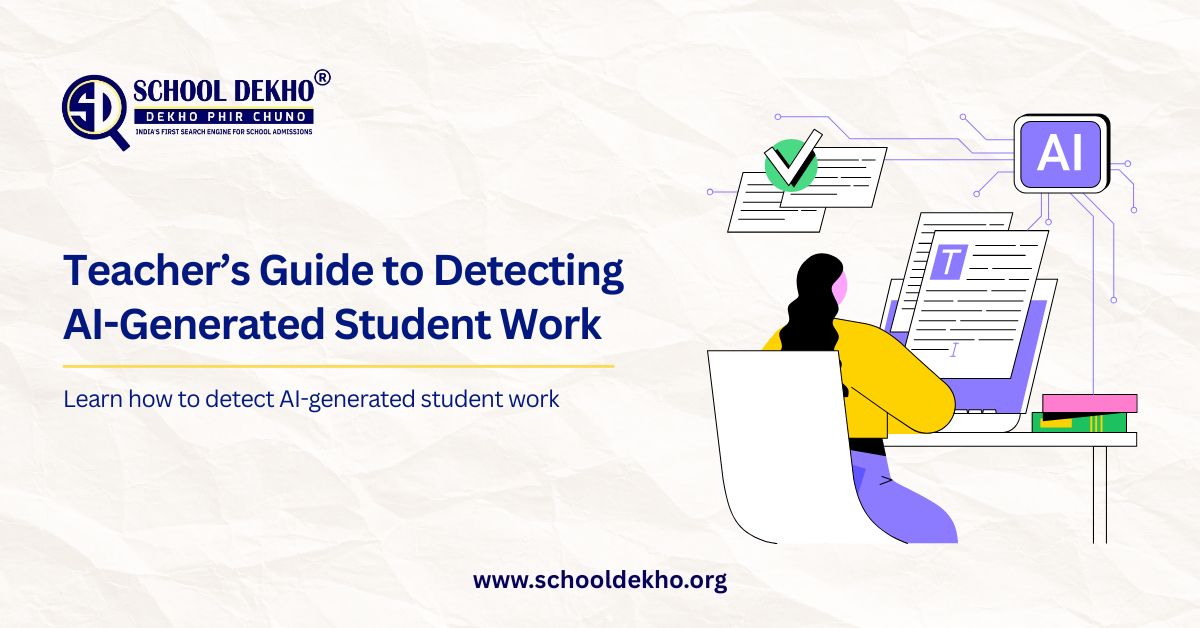
AI tools are now a part of student life. Many students use AI tools to get ideas, fix grammar, or sometimes even write assignments. As a teacher, this can be really confusing. You may read a paper. Think, "This does not sound like my student."
You are not alone; teachers around the world are facing this challenge. The good news is that you can understand and handle this situation in a way.
This guide will help you learn how to detect AI-generated student work. It will show you how to do it step by step using methods that actually work in classrooms. The focus is not on catching students, but on understanding how students learn and making sure the students' work is truly their own.
Understanding AI Detection
AI detection refers to the process of identifying whether a piece of writing may have been created by artificial intelligence. Various tools analyze text patterns, sentence structures, and word choices to determine if content shows signs of AI-generated writing.
However, it is important to remember that these tools are not always accurate. They can make mistakes and should not be treated as definitive proof. Instead, they provide an indication that a piece of writing may require closer review.
It is like when a smoke alarm goes off. It tells you that something may be wrong, but it does not tell you exactly what caused the problem. In the same way, an AI detector for teachers can highlight potential concerns in a student's work, but it cannot determine with certainty whether AI was used.
That is why teachers should not rely solely on these tools when making decisions. The best approach is to combine detection results with professional judgment, previous writing samples, and an understanding of each student's writing style.
When these methods are used together, teachers can develop a more complete picture of what may be happening with a student's work.
Why More Students Are Using AI Today
AI tools are now really easy to use. Students can type in a question. Get a full answer in just a few seconds. This convenience is a reason why AI use is growing so fast in education.
Many students use AI because it saves them time. When they feel stressed about deadlines, AI seems like a fix. Some students also use it because they don't feel confident in their writing, especially if English isn't their first language.
Another reason students use AI is that they get confused about the rules. If teachers don't clearly say what's allowed, students might think AI use is okay in all cases.
The real problem isn't AI itself. AI can actually be helpful if used correctly. The issue starts when students rely on it too much and stop thinking for themselves. This can hurt their learning and weaken their writing skills over time.
As a teacher, your goal isn't to ban AI. Your goal is to make sure students are still learning, thinking, and getting better.
A Simple Step-by-Step Way to Detect AI Writing
Detecting AI writing gets easier when you have a plan, not just a guess.
The first thing to do is to know your students' way of writing. This is super important. You can ask students to write tasks in class on their own. These samples show their words, how they build sentences,s and what mistakes they usually make. Keep these samples for comparison.
Next, check if something feels off. Sometimes a paper might sound too good or very different from what the student writes. Trust your gut. Always look for more proof.
After that, you can use an AI detector to identify potentially AI-generated writing. Tools like GPTZero or Turnitin can help analyse the text and highlight sections that may have been written by AI. However, AI detectors only provide indications, not definitive proof. Use them as a starting point for further review.
Then compare the work with what the student wrote. Real improvement happens slowly. If the writing suddenly gets much better,r it might need a look.
Another good way is to check how the writing was done. Look at drafts or version history if you have it. Real writing usually shows progress, with edits and changes. AI-generated work might appear suddenly with few changes.
You should also check the sources used in the assignment. AI tools sometimes make up references. Try to see if the sources really exist and match the content.
Finally, talk to the student. Ask them to explain their ideas or describe how they did the work. Students who wrote their work can usually explain it clearly. If they struggle to explain points,s it might be a sign that they relied too much on AI.
At the end, put all your findings together. Never depend on one clue. A fair decision comes from looking at the picture.
Common Signs That Writing May Be AI-Generated
When you read something that was written by a computer,r it can look really good at first. If you read it carefully, you can see some things that do not look right.
One thing you might see is that the writing is too good. There are no mistakes, and the sentences all sound nice. This is not like how people write. Most people make mistakes when they write, and that is okay.
Another thing you might see is that the writing does not sound like it was written by a person. When people write,e they usually include their thoughts and feelings. They also have their way of writing that is unique. Computer writing often sounds like it could have been written by anyone.
You might also notice that the writing is really different from what the person writes. If someone usually writes simple sentences, es but then they write something really long and complicated, that can be a sign that something is not right.
This can make the writing sound boring and not very interesting, and running a paper through a free AI detector is a fast way to flag that kind of repetitive pattern before a deeper manual review.
In some cases,s the writing might sound good at first. It does not really mean anything. The sentences might look good. They do not really explain anything or help you understand the topic. Computer writing about a topic like Artificial Intelligence can look good. Not really saying anything about Artificial Intelligence.
How AI Detection Tools Actually Work
AI detection tools look at how people write and how computers write. They check things like how the sentences are and what words are used. Then they compare this to a lot of things that people have written and things that computers have written.
They give a score that says if something was probably written by a computer. This score is, like a guess.
These tools are not perfect. Sometimes they get it wrong. Say that something a person wrote was written by a computer. This is called a positive. It happens to students who write in a neat and organized way.
AI is getting better at writing all the time. So it is getting harder to tell if a person or a computer wrote something.
That is why we should be careful when we use these tools. We should not just use them to make decisions. AI detection tools and other things should be used together.
Smart Ways to Reduce AI Misuse in Your Classroom
Preventing AI misuse is often easier than detecting it. Start by making rules about AI use. For example, give examples so students know what is allowed.
Here are some more ideas:
- Design assignments that need thinking. When tasks are based on experiences or local topics, AI cannot easily replace student input.
- Have students write more in class. This helps you understand their abilities and makes it easier to tell if they are using AI.
You can also:
- Ask students to submit drafts and show their progress. This makes it easier to see how their work develops over time. Using an AI detector built for teachers alongside draft reviews gives you a clearer picture of where student effort ends and AI begins.
- Encourage presentations and discussions. When students explain their work, it shows they really understand it.
Importantly, you teach responsible AI use. Show students that AI can help with ideas and editing. It should not replace their own thinking and work with AI. Students should use AI as a tool, not a substitute.
The Future of AI in Education
AI is expected to become more important in the future. Students may use AI tutors that are available anytime. This will make learning more personalized for students, and AI tutors will play a role in that.
AI will help students learn in a way that suits them best and create a balanced classroom where technology supports education instead of replacing it.
.webp)
.webp)