
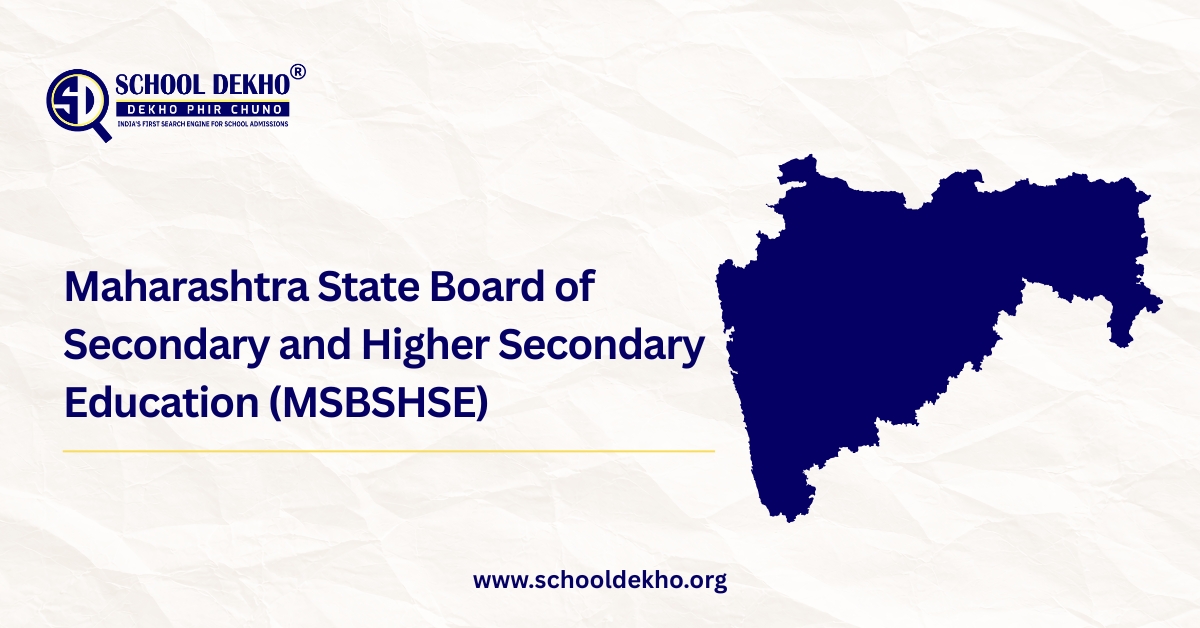
The Maharashtra State Board of Secondary and Higher Secondary Education (MSBSHSE), commonly known as the Maharashtra Board, is the statutory and autonomous body responsible for regulating secondary and higher secondary education in the state of Maharashtra, India. Established under the Maharashtra Secondary Boards Act, 1965 (amended in 1977 to explicitly include higher secondary education), the board conducts the Secondary School Certificate (SSC) examination for Class 10 and the Higher Secondary Certificate (HSC) examination for Class 12. Headquartered in Pune, MSBSHSE operates under the Ministry of School Education, Government of Maharashtra, and serves as one of India’s largest state education boards by enrollment, second only to the Central Board of Secondary Education (CBSE) in terms of high school student numbers.
The board’s jurisdiction covers the entire state of Maharashtra, overseeing curriculum development, textbook prescription, school affiliations, examination conduct, and result declaration. It plays a pivotal role in shaping educational standards, promoting regional linguistic and cultural elements (with Marathi as the primary medium alongside English), and preparing students for higher education and competitive examinations. With millions of students appearing annually, MSBSHSE significantly influences the state’s human resource development and aligns with national policies such as the National Education Policy (NEP) 2020.
Quick Facts
- Founded: 1 January 1966
- Headquarters: Pune, Maharashtra
- Jurisdiction: Maharashtra (state-wide, with nine divisional boards)
- Type: Statutory autonomous state board of education
- Official Website: mahahsscboard.in
- Parent Organization: Ministry of School Education, Government of Maharashtra
- Key Examinations: SSC (Class 10) and HSC (Class 12)
- Current Leadership (as of 2026): Chairperson – Sharad Gosavi; Secretary – Anuradha Oak (subject to periodic appointments)
- Annual Examinees (approximate, 2025-26): SSC – over 16 lakh; HSC – over 15 lakh
History and Establishment
The origins of organized secondary education in Maharashtra trace back to the pre-independence era, when various provincial boards and missionary institutions managed schooling. Post-independence, the need for a unified state-level regulatory body became evident to standardize curricula, examinations, and affiliations across a linguistically and culturally diverse region.
The Maharashtra Secondary Boards Act, 1965, laid the foundation for the board’s creation. It was formally established on 1 January 1966 as the Maharashtra State Secondary Education Boards, initially focusing on secondary (Class 10) education. The 1977 amendment expanded its mandate to higher secondary (Class 11-12) education, renaming it the Maharashtra State Board of Secondary and Higher Secondary Education. This shift integrated junior colleges into the board’s framework and enabled the conduct of the HSC examination.
Key milestones include:
- 1966: Inception and first SSC examinations.
- 1977: Amendment incorporating HSC and renaming.
- 1980s-1990s: Expansion of divisional boards for decentralized administration; introduction of centralized evaluation.
- 2000s: Digital initiatives begin with online result portals.
- 2010s: Syllabus revisions for alignment with national standards; integration of vocational streams.
- 2020: Announcement of merger considerations with other education boards; COVID-19-driven syllabus rationalization.
- 2025-2026: Phased implementation of NEP 2020-aligned curriculum, shifting toward a 5+3+3+4 structure and gradual adoption of NCERT-based elements.
The board evolved from a regulatory entity to a comprehensive education authority, emphasizing equity, access, and quality in a state with significant rural-urban divides.
Objectives and Functions
MSBSHSE’s primary objectives, as enshrined in the 1965 Act, are to:
- Prescribe curricula, syllabi, and textbooks for secondary and higher secondary education.
- Conduct fair and standardized public examinations (SSC and HSC).
- Grant recognition and affiliation to schools and junior colleges.
- Advise the state government on matters of secondary and higher secondary education.
- Promote educational research, teacher training, and quality improvement.
- Ensure equitable access, including provisions for differently-abled students and regional languages.
Core functions include:
- Curriculum Development: Formulating subject-wise syllabi for SSC (general) and HSC (Science, Commerce, Arts, and Vocational streams).
- Examination Management: Scheduling, conducting, evaluating, and declaring results for SSC and HSC twice a year (main in February-March; supplementary in July).
- Affiliation and Recognition: Regulating standards for affiliated institutions.
- Evaluation and Certification: Centralized assessment with provisions for revaluation and photocopy of answer sheets.
- Digital and Administrative Services: Issuing digital marksheets, migration certificates, and online verification.
- Policy Implementation: Aligning with state and national education policies, including NEP 2020 reforms.
The board also appoints paper setters, examiners, and moderators while maintaining confidentiality and fairness through divisional oversight.
Organizational Structure
MSBSHSE operates through a two-tier structure: the State Board (apex body in Pune) and nine Divisional Boards for decentralized execution.
State Board Governance:
- Executive Council: Handles executive functions.
- Academic Council: Advises on curricula, syllabi, and academic matters.
- Finance Committee: Oversees budgeting and financial matters.
- Boards of Studies: Subject-specific committees for curriculum design.
- Other Committees: For examinations, research, and grievances.
Leadership includes the Chairperson, Secretary, and elected/nominated members representing educators, officials, and experts.
Divisional Boards (nine in total):
- Pune
- Mumbai
- Nagpur
- Chhatrapati Sambhajinagar (Aurangabad)
- Kolhapur
- Amravati
- Nashik
- Latur
- Konkan
Each divisional board manages local school affiliations, examination centers, paper distribution, evaluation, and result processing for its region. This structure ensures efficient administration across Maharashtra’s diverse geography.
Curriculum and Examination System
Syllabus Structure:
- SSC (Class 9-10): Compulsory subjects include English, Marathi (or other regional language), Mathematics (Algebra & Geometry), Science & Technology, Social Sciences (History, Geography, Political Science, Economics). Optional subjects: Hindi, Sanskrit, etc.
- HSC (Class 11-12): Streams include Science (Physics, Chemistry, Biology/Maths, etc.), Commerce (Accountancy, Economics, Organisation of Commerce), Arts (History, Political Science, Sociology, etc.), and Vocational/Technical streams.
- Mediums: Primarily Marathi and English; limited options in Hindi, Urdu, etc.
- Recent reforms: 25% syllabus reduction in select years for stress reduction; ongoing alignment with NEP 2020, including competency-based learning and multidisciplinary approaches. Textbooks are developed by the Maharashtra State Bureau of Textbook Production and Curriculum Research (Balbharti).
Exam Pattern:
- Mode: Offline (pen-and-paper).
- Duration: 3 hours per paper.
- Marking: Most subjects – 80 marks theory + 20 marks internal assessment/practical/project. Science practicals: 70 theory + 30 practical.
- Question Types: Mix of objective (MCQs ~25%), short-answer, and long-answer questions.
- Passing Criteria: Minimum 35% aggregate per subject and overall.
- SSC Specifics: Best of 5 rule for percentage calculation in some cases.
- HSC Specifics: Stream-specific papers; total 600 marks (best of relevant subjects for higher education).
Examinations are held in February-March, with results typically declared in May-June. Centralized evaluation camps and flying squads ensure integrity.
Affiliation and Schools
MSBSHSE affiliates government, aided, and unaided schools and junior colleges meeting prescribed infrastructure, staffing, and curricular standards. As of recent data, secondary and higher secondary institutions number approximately 29,641, with combined enrollment of around 63.6 lakh students (Economic Survey 2025-26). Earlier figures indicated over 10,000 affiliated schools in 2020, reflecting steady growth.
Affiliation Process:
- Application to the concerned Divisional Board or District Education Officer.
- Submission of documents (land records, building plans, staff qualifications, financial viability).
- Inspection by board officials.
- Provisional/permanent affiliation upon compliance with rules (e.g., playground, library, qualified teachers).
- Ongoing monitoring for renewal and standards maintenance.
The board also recognizes vocational training centers and supports inclusive education.
Digital Initiatives and Reforms
MSBSHSE has modernized operations through:
- e-MarkSheet Dashboard: Online marksheet verification and issuance.
- DigiLocker Integration: Digital storage of certificates and marksheets.
- Mobile App and Portal: For hall tickets, results, and student services.
- Online Applications: For examinations, revaluation, and migration certificates.
- NEP 2020 Alignment: Phased rollout of 5+3+3+4 structure starting Class 1 in 2025-26, with bridge courses and NCERT-influenced textbooks by 2028.
These initiatives enhance transparency, reduce paperwork, and improve accessibility, especially in rural areas.
Achievements and Impact
MSBSHSE has educated generations of students, contributing to Maharashtra’s high literacy rates and skilled workforce. Key statistics include annual examinee numbers exceeding 30 lakh combined and consistent high pass percentages (often above 85-90% in recent years). The board’s curriculum integrates regional history, languages, and vocational skills, fostering cultural pride and employability.
Notable impacts:
- Preparation for state-level entrance exams (MHT-CET, etc.).
- Support for inclusive education and girl-child enrollment (nearly 48% in primary/secondary).
- Large-scale digital certification benefiting millions.
- Contribution to national education goals through alignment with CBSE/NCERT elements.
Challenges and Criticism
Despite successes, the board faces issues such as:
- Examination Malpractices: Occasional paper leak allegations and cheating incidents, leading to calls for stronger security (e.g., 2026 SSC Geography paper controversy).
- Evaluation Delays and Errors: Centralized checking sometimes results in revaluation demands.
- Rural-Urban Disparities: Infrastructure gaps in remote areas, with reports of zero-enrollment schools (394 noted in recent UDISE data).
- Syllabus Load and Reforms: Past criticisms of heavy content; ongoing NEP transition poses implementation challenges.
- Administrative Controversies: Issues like caste column on hall tickets (later removed) and supervisor rotation policies.
The board addresses these through flying squads, CCTV monitoring, and policy reviews.
Recent Updates (2022–2026)
- 2022-2024: COVID-era syllabus rationalization (up to 25-35% reduction); enhanced online services.
- 2025: Announcement of CBSE-curriculum adoption in phases for state schools, starting Class 1; NEP 2020 structural shift to 5+3+3+4.
- 2026: February-March examinations for SSC (over 16 lakh students) and HSC (over 15 lakh); tender processes for marksheets and digital services; continued emphasis on digital hall tickets and counseling for students.
Ongoing focus remains on competency-based education and digital equity.
Comparison with Other Boards
| Aspect | MSBSHSE (Maharashtra Board) | CBSE | ICSE (CISCE) | Other State Boards (e.g., UP/TN) |
|---|---|---|---|---|
| Scope | State-specific, largest enrollment after CBSE | National, uniform | National, more urban-focused | State-specific |
| Curriculum | Regional emphasis (Marathi, Maharashtra history); streams with vocational options | NCERT-based, pan-India focus | Detailed, literature-heavy | Varies; often regional languages |
| Medium | Marathi/English primarily | English primarily | English | Regional + English |
| Exam Pattern | 80/20 theory-internal; objective + subjective | Similar, with more MCQs in recent years | Rigorous subjective | Similar to MSBSHSE |
| Recognition | Excellent for state higher education; NEP alignment ongoing | Widely recognized nationally/internationally | Strong for international universities | Good within state; variable nationally |
| Strengths | Cultural relevance, large scale, affordability | Competitive exam prep, uniformity | In-depth learning, analytical skills | Localized access |
| Challenges | Regional disparities, occasional leaks | High competition | Heavier syllabus | Varying quality |
MSBSHSE balances state identity with national standards, making it suitable for students pursuing local careers or state entrances, while CBSE/ICSE cater more to mobility and global opportunities.
FAQs
1. What is the full form of Maharashtra State Board?
Maharashtra State Board of Secondary and Higher Secondary Education (MSBSHSE).
2. Where is the Maharashtra Board headquarters located?
Pune, Maharashtra.
3. What exams does MSBSHSE conduct?
Secondary School Certificate (SSC/Class 10) and Higher Secondary Certificate (HSC/Class 12).
4. How can I check Maharashtra Board results?
Via the official website mahahsscboard.in or DigiLocker.
5. What is the passing marks for SSC/HSC?
Minimum 35% in each subject and aggregate.
6. How to download Maharashtra Board syllabus?
From the official website under syllabus section or Balbharti portal.
7. What is the affiliation process for schools?
Apply to the Divisional Board with required documents; undergo inspection.
8. Does Maharashtra Board follow NEP 2020?
Yes, with phased implementation of 5+3+3+4 structure and curriculum updates starting 2025-26.
9. What are the streams in HSC?
Science, Commerce, Arts, and Vocational.
10. How many students appear for Maharashtra SSC exams?
Approximately 16 lakh annually (2026 figures).
11. Is the Maharashtra Board syllabus reduced?
Select reductions applied in recent years; check latest on official site.
12. How to apply for revaluation or photocopy?
Online through the board portal within stipulated time after results.
13. What languages are offered in SSC?
Marathi (compulsory in many cases), English, Hindi, Sanskrit, etc.
14. Does MSBSHSE provide digital marksheets?
Yes, via e-MarkSheet and DigiLocker.
15. How does Maharashtra Board compare to CBSE for competitive exams?
Both prepare students well, but CBSE aligns more directly with national entrances; MSBSHSE excels in state-specific exams.Conclusion
The Maharashtra State Board of Secondary and Higher Secondary Education remains a cornerstone of educational governance in Maharashtra, delivering standardized, accessible, and culturally relevant secondary and higher secondary education to millions. Through its robust structure, continuous reforms, and digital advancements, MSBSHSE not only upholds academic excellence but also adapts to evolving national policies like NEP 2020. As it navigates challenges and embraces modernization, the board continues to empower students, shaping the future of the state and contributing significantly to India’s educational landscape. For the latest updates, official notifications, and resources, refer to mahahsscboard.in.


.webp)
.webp)