
CBSE, ICSE or Cambridge IGCSE? What the Class 10 Exams Actually Look Like
Choosing a school often means choosing a board, and for many parents that is the hardest part. CBSE, ICSE and Cambridge IGCSE are all respected, all lead to good colleges, and all claim to build real understanding. So how do you decide?
One of the most useful things you can do is look past the brochures and see how each board actually examines students at the end of Class 10. In this guide, we compare the three side by side and explain what your child would really be sitting.
The three boards at a glance
How CBSE examines Class 10
From 2026, CBSE holds two board exams for Class 10. The first, in February, is compulsory. The second, in May, is optional and lets students improve their scores in up to three subjects. Questions are increasingly competency-based, with case studies and source-based questions alongside short and long answers.
CBSE publishes free sample question papers and marking schemes every year. If your child is moving to a CBSE school, these are the best place to start.
How ICSE examines Class 10
The ICSE is conducted by CISCE, which was set up in 1958 and also runs the ISC examination for Class 12. ICSE is known for its detailed syllabus and strong emphasis on English, with longer written answers and internal assessment in many subjects. Parents often describe it as thorough and language-heavy, which suits children who enjoy reading and writing.
How Cambridge IGCSE examines Class 10
Cambridge IGCSE works differently, and this is where most parents have questions.
Core and Extended. In many subjects, students are entered for either the Core or the Extended tier. Core covers the central content and allows grades C to G. Extended covers additional, harder content and allows the full range from A* to G. The school usually decides which tier suits each child.
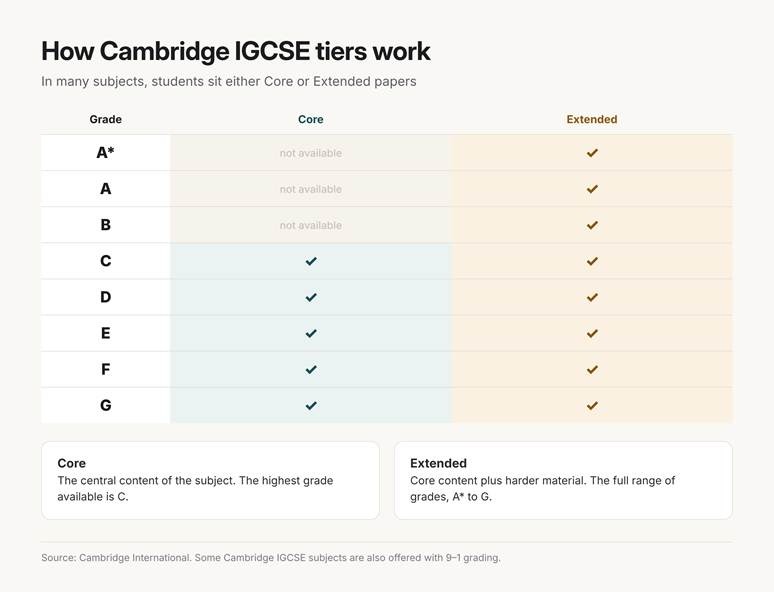
How Cambridge IGCSE Core and Extended tiers work
The March series. Cambridge runs a March exam series specially for India, covering the most popular IGCSE and AS & A Level subjects, so students sit their exams at the same time as national boards. March results come out in May, according to Cambridge’s India FAQs.
More than one paper per subject. In IGCSE Mathematics, for example, Core students sit two Core papers and Extended students sit two Extended papers, and the questions build from straightforward to quite demanding within each paper.
The best way to understand this is to look at one. Open a recent paper with your child, read a few questions from the start and a few from the end, and you will quickly see the level and style. Past IGCSE Maths papers can be read online for free on SchoolNinja (https://school.ninja/igcse/mathematics/cambridge), with the mark schemes alongside, so you can also see exactly how marks are awarded. For revision notes on the same syllabus, many students also use Save My Exams (https://www.savemyexams.com/igcse/maths/cie/), though most of its material sits behind a subscription.
Is IGCSE recognised in India?
Yes. This is one of the most common worries we hear from parents.
• The Association of Indian Universities (AIU) recognises passes in five Cambridge IGCSE or O Level subjects, including English Language, as equivalent to Class 10.
• Indian universities accept Cambridge International A Levels for admission.
• For NEET-UG, Cambridge students need a pass in AS Level English Language, along with the required science subjects.
• More than 700 schools in India now offer Cambridge programmes, according to Cambridge International.
Which board suits which child?
There is no single best board. A rough guide:
• CBSE suits families who may move cities (it has the widest network of schools), and students aiming for national entrance exams like JEE and NEET, whose syllabus follows NCERT closely.
• ICSE suits children who enjoy languages and detailed study, and families who value a broad, thorough syllabus.
• Cambridge IGCSE suits children who do well with choice and application-based questions, and families considering higher education abroad, while still keeping Indian universities open.
Questions to ask the school
1. Which board does the school follow from Class 9, and does it change after Class 10?
2. For IGCSE schools: which subjects are offered, and how does the school decide Core or Extended?
3. Does the school use past papers and mark schemes in class from Class 9?
4. What did last year’s Class 10 and Class 12 students go on to study?
5. Is there extra support for students moving from another board?
FAQs
Can my child move from IGCSE to CBSE for Class 11? Yes. Many students do. It is worth checking subject combinations with the new school early.
Is IGCSE harder than CBSE? Not necessarily. It is different. Extended papers can be demanding, but the Core and Extended tiers mean students can be entered at the right level.
When are IGCSE results declared for the March series? In May, according to Cambridge.
Final words
Board choice matters, but it is only one part of choosing the right school. Look at real exam papers, talk to teachers and current parents, and think about how your child learns best. If you would like help comparing schools by board, fees and location, School Dekho’s counsellors can guide you through the options in your city.
References
1. Cambridge International. Cambridge in India: frequently asked questions (2025).
2. Cambridge International. What is the difference between IGCSE Core and Extended? Help centre.
3. Cambridge International. Cambridge International in India.
4. AACRAO EDGE. “CBSE double board exams starting from 2026”.
5. Council for the Indian School Certificate Examinations (CISCE), official website.






.webp)