
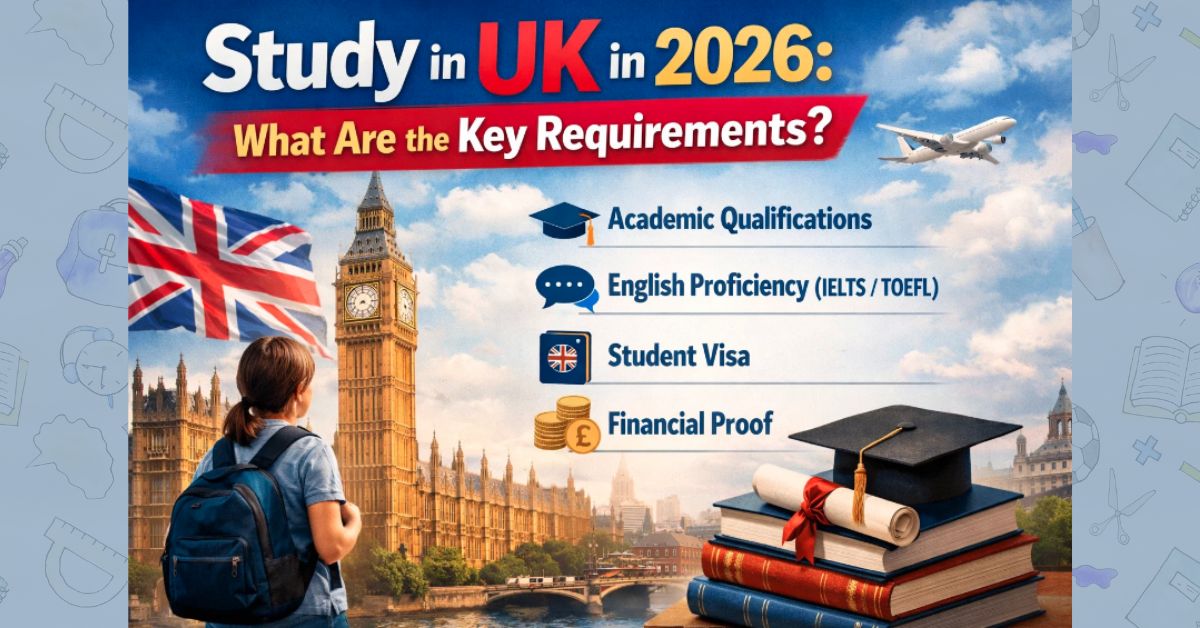
Every year, hundreds of thousands of students plan to study in UK, given the range of benefits it offers. The quality of education, top facilities and the greatness it offers are highly appealing to students. However, getting an entry to a UK college is not an easy job. It is because of the strict entry conditions. This makes it vital for students to start preparing early. Also, getting familiar with all the entry conditions before applying simplifies the journey. With this article, you will get to know all the admission requirements in detail with ease.
Academic Entry Requirements
For students planning to study in UK, learning about academic requirements is the first step. The colleges keep clear academic standards for entry purposes.
Minimum Academic Conditions
For admission to UG courses, students are required to hold a high school qualification from a recognised board. Colleges in the UK generally expect competitive grades or equal grading criteria.
Securing a seat in a PG course requires a relevant bachelor's degree from a recognised institution. Most colleges in the UK usually require a 2:1 or equivalent in the relevant field.
Course Specific Requirements
Applying to some particular degrees in the UK may require prior expertise. Simply stated, colleges may ask for previous studies with a specific background.
For example, getting a seat in an MBA program in the UK generally requires professional work experience. Furthermore, for a creative course, you may be asked to present a portfolio showcasing your practical skills.
This makes it crucial for students to carefully review the eligibility conditions before applying to any course.
English Language Requirements
International students who do not have English as their first language are required to provide their proof of language through standardized tests such as PTE, TOEFL or IELTS.
Requirements for the proficiency scores vary depending on the college and course level. The accepted scores for each test are:
PTE - 59 to 65+ overall (min 59 in each component).
TOEFL - 72 to 90+ overall (minimum skill apply)
IELTS - Commonly 6.0 with no band below 5.5 for UG courses and 6.5 - 7.0 with no band below 6.0 for PG courses.
Score Validity and Planning
The scores of the English test are generally valid for two years. This allows students to plan accordingly and apply to colleges.
These tests are designed to test the academic English of the students. It requires students to get familiar with test patterns and the format of each for effective scores. Moreover, these tests demand regular practice that improves self-trust and performance on the actual test day.
Financial Requirements to Study in UK in 2026
For successful admission to a UK college and securing a student visa, providing financial proof is necessary. This is generally to prove that you can pay tuition fee and afford living costs. The financial proof required from students is:
Tuition Fees: Students have to showcase the full amount for the first year as stated in the CAS letter. The average fee range for global students is generally around £11,400 to over £38,000.
Living expenses: For students planning to live in London, showcasing financial proof of £1,334 per month for up to 9 months is crucial. Moreover, for students planning their stay outside London, proof of £1,023 per month for up to 9 months is required.
The proof of funds is generally shown with the help of bank reports or sponsorship letters, held for at least 28 days.
Financial requirements to study in the UK also include planning for a visa and health insurance. For a UK student visa, £490 is to be paid for the application process, and IHS insurance is over £1,000 per year.
Application Documents Checklist
For students planning their higher studies in the UK, preparing a list of documents is crucial. This helps support the application and reduce any processing delays. The list of documents required by the students is generally classified into two major categories.
Core Application Documents
The list of documents essential for study in UK is:
Confirmation of Acceptance for Studies (CAS) letter: An official document issued by the college after you accept the offer letter.
Valid Passport: Current passport with at least 6 months of validity and one blank page.
Proof of Funds: Bank reports, sponsorship letter or other evidence showcasing the required financial proof.
English Language Test: Scorecard of accepted tests, including PTE, IELTS or TOEFL
TB Test Results: Required for students from selected countries, including India.
Academic Documents: Requires all the necessary transcripts or certificates
ATAS Certificate: Required if applying for certain PG courses (science or technology).
College Application Checklist
The documents that need to be submitted to the college are:
Academic Transcripts & Degree
Personal Statement (Statement of Purpose)
Letters of Recommendation
CV/Resume (if required)
Meeting all these requirements is crucial for every aspiring student planning their higher studies in the UK. However, understanding them clearly and applying them with confidence requires correct planning and expert advice.
How Professional Guidance Can Simplify Your UK Admission Journey?
Meeting all the requirements alone can feel challenging initially. It is where students can seek guidance from experts, who can actually simplify each step for them. Here are the top ways in which guidance from experts can help you get admission in the UK.
1. University & Course Selection: Experts assess your profile and help you select the best course and college according to your interests and career goals. This helps in finalising top options for colleges and making an informed choice.
2. Application Support: Crafting a compelling application is a crucial part of the admission process. Experts can help you improve SOP structure and enhance the complete presentation. Moreover, consultants help recheck all the documents before final submission. This helps in reducing the prospects of rejection.
3. Visa & Finance Help: Seeking advice from experts helps you organise financial proof correctly. Also, you can get help with a visa application and other processes.
Final Thoughts
Summing up, the opportunity to study in the UK is no wonder the best thing for any aspiring student. However, the strict admission requirements often discourage students. With clear planning and advice, you can easily navigate the admission process. Start your preparation early, meet academic requirements, prep smartly for the English test with the help of one-on-one coaching or taking an IELTS / PTE mock test, manage finances as a priority, and you are good to go.



.webp)
.webp)